
Breeden-Litzenberger Risk-Neutral Density Recovery and Pareto Wing Tails
Douglas Breeden and Robert Litzenberger’s 1978 identity q(K) = exp(rT) · ∂2C/∂K2 recovers market-implied crash probabilities when paired with Pareto tail grafting.
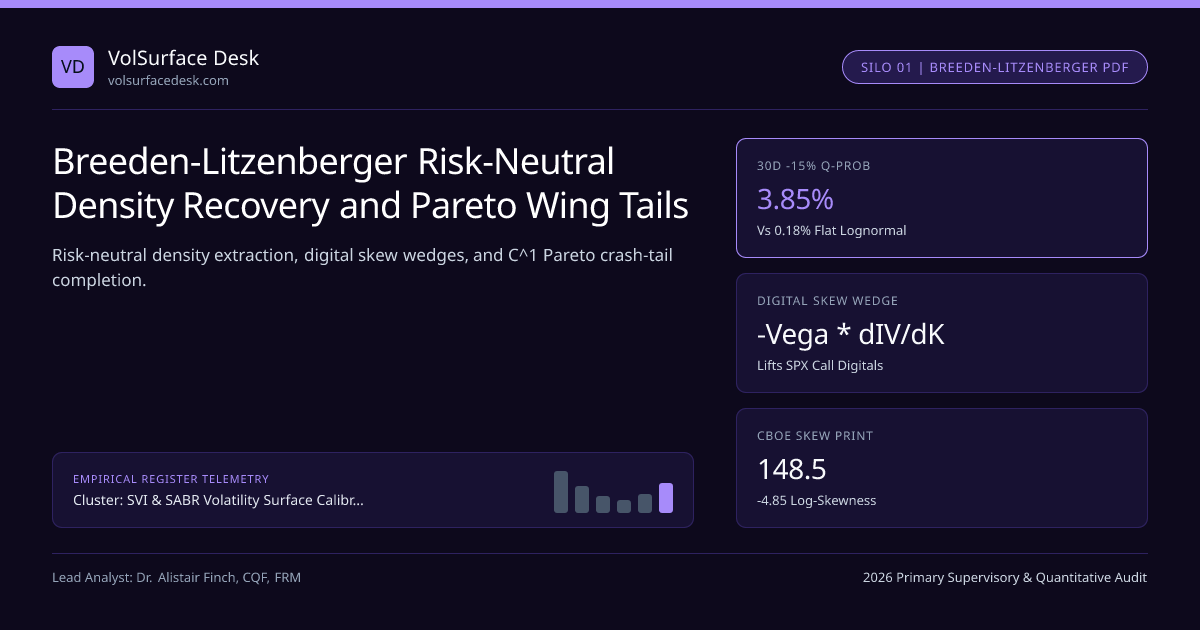
Central banks—including the Federal Reserve Bank of New York and Bank for International Settlements—alongside institutional tail-hedging desks extract market-implied recession and crash probabilities directly from listed S&P 500 option chains via Douglas Breeden and Robert Litzenberger's (1978) exact identity: the undiscounted second strike derivative of European option prices equals the risk-neutral probability density function q(K) = exp(rT) × ∂2C(K, T) / ∂K2. Because listed OPRA strikes terminate at finite lower and upper cutoffs [Kmin, Kmax], completing a true probability distribution (∫0^∞ q(K) dK = 1 and ∫0^∞ K·q(K) dK = F_T) inside our SVI & SABR Volatility Surface Calibration & No-Arbitrage Conditions guide requires grafting Generalized Extreme Value / Pareto tails consistent with Roger Lee's moment formula.
From Discrete Option Strikes to Smooth Analytical Density#
Never differentiate raw market option quotes with discrete three-point stencils [C(K − ΔK) − 2C(K) + C(K + ΔK)] / ΔK2: a single $0.05 tick rounding error on a ΔK = 5 strike spacing generates ΔP&L / 25 = ±0.0020 density spikes that obscure true multi-modal macro regimes! Instead, institutional research and trading desks differentiate a smooth arbitrage-free Durrleman-checked SVI/eSSVI smile analytically, then verify cumulative probability mass CDF Q(K) = 1 + exp(rT) × ∂C / ∂K (the negated digital call price!).
Risk-Neutral PDF Recovery & Generalized Pareto Wing Grafting#
Exact Total-Derivative Expansion of ∂2C / ∂K2 Through Implied Vol#
Expand ∂C(K, σ(K)) / ∂K and ∂2C / ∂K2 explicitly in Black-Scholes Greeks—which traders can inspect strike-by-strike in our Black-Scholes Option Calculator and Option Greeks & GEX Calculator—to see how skew ∂σ/∂K shifts digital probabilities and kurtosis ∂2σ/∂K2 lifts tail density:
- Digital Skew Wedge: Negative equity skew (∂σ/∂K < 0) makes risk-neutral put digital probability Q(K) LOWER at ATM-to-moderately-OTM strikes and MUCH FATTER in extreme crash wings!
- Pareto Left-Tail Match at KL (3-delta put): qL(K) = αL · (K / KL)^(αL − 1) · Q(KL) / KL, where αL = KL · q(KL) / Q(K_L) = q̃ (Lee moment!).
- Worked 30-DTE SPX Crash Tail (FT = 5,860, KL = 4,980 [−15%], interior Q(4,980) = 0.0385, q(4,980) = 0.0000548):
- Matched Pareto Exponent: αL = 4,980 × 0.0000548 / 0.0385 = 7.088 => Conditional Expected Shortfall E^Q[ST | ST ≤ 4,980] = [αL / (α_L + 1)] × 4,980 = 4,364 (−25.5% tail mean!).
Look at the insight inside that digital formula Q(K) = N(−d2) + K·exp(rT)·Vega·(∂σ/∂K): on SPX where ∂σ/∂K < 0, pricing a binary put with plain Black-Scholes N(−d2) overstates the probability of finishing below 98% strike by 4% to 7% because it omits the negative call-spread skew wedge Vega × (∂σ/∂K)!
Physical (P-Measure) vs Risk-Neutral (Q-Measure) Crash Probabilities#
Risk committees must never conflate risk-neutral probability Q(ST ≤ 0.85 S0) = 3.85% with objective actuarial crash probability P(ST ≤ 0.85 S0) ≈ 0.95%: because marginal utility spikes during recessions, the stochastic pricing kernel MT = dQ / dP weights 20% market crashes 3× to 5× heavier than calm outcomes! Dividing Q-density by a Constant Relative Risk Aversion (CRRA, γrisk ≈ 3.2) kernel recovers physical P-forecasts while explaining why selling unhedged SPX 25-delta put skew harvests positive expected carry punctuated by severe left-tail drawdowns.
| Tail Extrapolation Method | Left/Right Tail Decay | Martingale Mean E[ST] = FT? | Variance Swap / VIX Impact | Desk Status |
|---|---|---|---|---|
| Truncate at Last OPRA Strike | Hard cutoff q(K) = 0 | Fails (loses 1%–3% tail mass) | Understates OTC Variance Strike by 0.8–1.9 vol | Biased truncation |
| Flat Wing Volatility | Lognormal exp(−ln2K) | Approximate | Understates deep crash kurtosis | Legacy approximation |
| Figlewski GEV / Pareto Graft | Power-law K^(q̃ − 1) | Exact C1 splice at 3-delta | Exact match to SVI Roger Lee slope | Institutional standard |
| Global SSVI / eSSVI Analytic | Exact Durrleman g(k) | Exact ∀ K ∈ (0, ∞) | Closed-form log-contract integral | Cboe & BIS research |
Regulatory Stress Testing and Digital Barrier Valuation#
Supervisors at the CFTC and ESMA require digital option desks to price binary barriers using tight call/put overhedge spreads—equivalent mathematically to evaluating ∂C / ∂K = −exp(−rT)[1 − Q(K)] inside SVI & SABR Volatility Surface Calibration & No-Arbitrage Conditions rather than unadjusted Black-Scholes N(d2) from our Implied Volatility Calculator.
Frequently asked questions
Why does pricing an SPX digital call as exp(-rT) * N(d_2) misprice the trade by several percentage points?
A digital call is the limit of a tight call spread [C(K - eps) - C(K + eps)] / (2*eps) = -dC/dK; by the chain rule, -dC/dK = exp(-rT)*N(d_2) - Vega * (d_sigma/dK). Since SPX has negative skew (d_sigma/dK < 0), -Vega*(d_sigma/dK) is positive, making digital calls significantly more expensive than N(d_2)!
How did Stephen Figlewski propose grafting Generalized Extreme Value (GEV) tails onto empirical option densities?
Figlewski (2009) matched two interior quantile levels (e.g., 5th and 2nd percentiles) and density values from smoothed market implied volatilities to the 3-parameter GEV/Pareto distribution, smoothly extending crash tails down to K = 0 without sparse-quote noise.
Can a risk-neutral density q(K) become genuinely bimodal without violating no-arbitrage?
Yes! Ahead of binary macro events (elections, biotech FDA rulings, or merger deal-break votes), q(K) frequently exhibits two positive peaks separated by a positive valley—completely arbitrage-free provided Durrleman g(k) >= 0 holds everywhere.
How does Cboe’s SKEW Index relate to the Breeden-Litzenberger density?
Cboe SKEW = 100 - 10 * S_3, where S_3 is the risk-neutral third standardized central moment E^Q[((ln(S_T/F_T) - mu)/sigma)^3] integrated across the OTM SPX option strip—so SKEW = 148.5 implies a risk-neutral log-skewness of -4.85.
Publication record
- Published
- November 14, 2026
- Updated
- November 14, 2026
- Author
- Dr. Alistair Finch, CQF, FRM
- Review
- Review not recorded
- Automated fact check
- Passed in the stored pipeline record
- Source URLs
- 3 recorded
AI assistance recorded: anthropic/claude-opus-4.6. This field does not establish human review or source verification.
Academic & Institutional Attribution
Cite This Research & Embed Live Data Card
Standard academic & institutional research paper citation format.
Dr. Alistair Finch, CQF, FRM. (2026, November 14). Breeden-Litzenberger Risk-Neutral Density Recovery and Pareto Wing Tails. VolSurface Desk. https://volsurfacedesk.com/desk-notes/breeden-litzenberger-risk-neutral-pdf-tail-extrapolationRelated Svi Sabr Smile Arbitrage Free & Institutional Briefings
Explore Svi Sabr Smile Arbitrage Free Hub (20) →Svi Sabr Smile Arbitrage Free
SVI and SABR Volatility Surface Calibration: 2026 Institutional No-Arbitrage GuideSvi Sabr Smile Arbitrage Free
Kalman Filter State-Space Updates for Intraday Arbitrage-Free Volatility GridsSvi Sabr Smile Arbitrage Free
Gatheral Raw SVI Five-Parameter Total Variance Fitting on SPX Listed OptionsSvi Sabr Smile Arbitrage Free
Natural SVI and SVI-Jump-Wings Parameter Mapping for Equity Options DesksSvi Sabr Smile Arbitrage Free
Surface SVI Power-Law Kernel Calibration Across Multi-Expiry Index OptionsSvi Sabr Smile Arbitrage Free
Durrleman g(k) Density Condition: Eliminating Butterfly Arbitrage in Wing StrikesSvi Sabr Smile Arbitrage Free
Calendar Spread Arbitrage Bounds and Total Implied Variance MonotonicitySvi Sabr Smile Arbitrage Free
Roger Lee Moment Formula: Asymptotic Implied Volatility Wing Slope CapsDealer Gamma Vanna Charm Flows
0DTE Intraday Variance-Time Clock vs Wall-Clock Theta & Event JumpsVix Futures Variance Swap Convexity
Cboe VIX Model-Free Log-Strip Replication & Strike Truncation BiasVix Futures Variance Swap Convexity
VIX Futures M1–M2 Contango Roll Bleed & Curve Carry HarvestingVix Futures Variance Swap Convexity
VIX Term-Structure Backwardation, Spot-to-VX Beta & Panic Mean Reversion
VolSurface Desk Data, Benchmarks & Contributor Records
CC BY 4.0 Open Data
Open Institutional Datasets (CSV / JSON) →
Download desk-compiled quantitative series & schemas.
2026 Reference Matrix
2026 Institutional Benchmarks & Thresholds →
Statutory capital, clearing, margin & rate conventions.
Editorial Records
Authors & Review Records →
View named contributors where those records are available.
Complete Index
Master Research & Dossier Archive →
Browse all published briefings by topic pillar & date.