
Surface SVI Power-Law Kernel Calibration Across Multi-Expiry Index Options
Gatheral-Jacquier Surface SVI (SSVI) couples every listed option expiry through ATM total variance theta_T and a power-law kernel phi(theta) to eliminate calendar arbitrage.
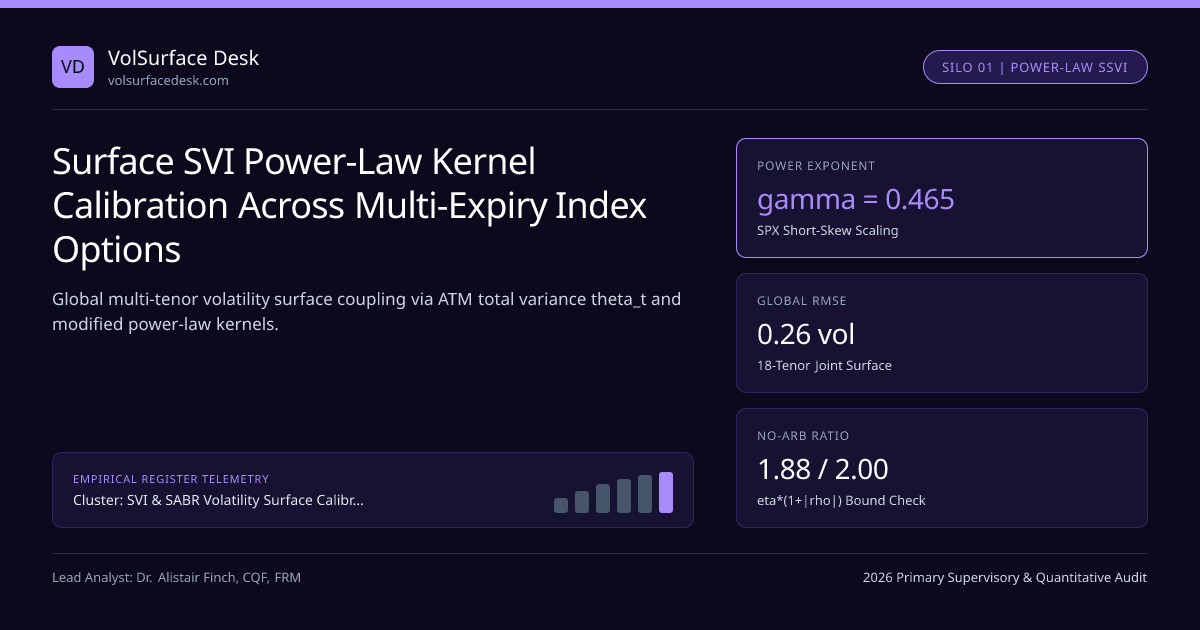
Calibrating 22 SPX expiration slices from 1-DTE dailies out to 3-year LEAPS with three global parameters plus an ATM variance curve θ_T allows Surface SVI (SSVI) to guarantee zero static butterfly and zero calendar spread arbitrage analytically across all log-moneyness and maturity pairs. Formulated by Gatheral and Jacquier (2014) and extended in our SVI & SABR Volatility Surface Calibration & No-Arbitrage Conditions cornerstone guide, SSVI resolves the central weakness of Gatheral raw SVI five-parameter slice fitting: independent slice hyperbolas inevitably cross in illiquid wings when calibrated one maturity at a time.
The SSVI Master Equation and ATM Variance Time Clock#
Instead of parameterizing total variance against calendar time T, SSVI treats ATM total implied variance θt = σBS2(0, t) × t as the intrinsic stochastic clock of the volatility surface: w(k, θt) = (θt / 2) × [ 1 + ρ·φ(θt)·k + √((φ(θt)·k + ρ)2 + (1 − ρ2)) ]
Here ρ ∈ (−1, 1) represents global spot-vol correlation, and φ(θ) > 0 is a smooth backbone kernel governing how ATM variance skew ∂w(0, θt)/∂k ÷ θt = (1/2)·ρ·φ(θ_t) decays with horizon. On equity index desks trading Cboe Volatility Index (VIX) and Euro Stoxx 50 options, empirical ATM skew follows a near-exact power law φ(θ) = η · θ^(−γ) with γ ∈ (0, 0.5]—and the modified power-law kernel φ(θ) = η / [θ^γ · (1 + θ)^(1 − γ)] to preserve bounded variance slopes at ultra-long maturities.
Global Power-Law SSVI Surface Calibration Pipeline#

Gatheral-Jacquier Global No-Arbitrage Theorems#
What makes SSVI indispensable for Dupire local volatility PDE finite-difference smoothing is that static no-arbitrage reduces to compact closed-form inequalities on θ_t and φ(θ):
- Theorem 4.1 (Calendar Arbitrage-Free): dθ_t/dt ≥ 0 and 0 ≤ d[θ·φ(θ)]/dθ ≤ (1/ρ2)·(1 + √(1 − ρ2))·φ(θ).
- Theorem 4.2 (Butterfly Arbitrage-Free): θ·φ(θ)·(1 + |ρ|) < 4 and θ·φ(θ)2·(1 + |ρ|) ≤ 4 for all θ > 0.
- Worked SPX 18-Expiry Strip (Oct 2026): calibrated ρ = −0.735, η = 1.082, γ = 0.465 => η(1 + |ρ|) = 1.877 ≤ 2.000 (Global Pass).
- 30-DTE Slice Evaluation (θ_30d = 0.00328): φ(0.00328) = 15.437, ATM skew ∂w/∂k(0) = −0.01861 with zero slice intersections.
Notice the algebraic elegance of the modified power-law form: whenever 0 < γ ≤ 1/2 and η(1 + |ρ|) ≤ 2, both Theorem 4.1 (calendar monotonicity) and Theorem 4.2 (Durrleman butterfly positivity) hold identically for every positive θ > 0 and every strike k ∈ (−∞, +∞)!
Heston-Like vs Power-Law Kernel Performance#
Gatheral and Jacquier originally tested two analytical kernels: the Heston-like kernel φ(θ) = [1 − (1 − exp(−λθ))/(λθ)] / (λθ) and the power-law kernel. Empirical tests across Cboe SPX and Eurex SX5E options confirm that Heston-like kernels flatten ATM skew far too slowly at long maturities and fail entirely to match 1-week to 2-week skew explosions—whereas power-law kernels with γ ≈ 0.47 mirror fractional volatility behavior analyzed in Rough Bergomi short-dated fractional skew models.

| SSVI Kernel Variant | Analytical φ(θ) Formula | Global Params | Short-End Skew Scaling | Desk Application & Tool |
|---|---|---|---|---|
| Heston-Like SSVI | (1 / λθ)·[1 − (1 − e^(−λθ)) / λθ] | 2 (ρ, λ) | Constant O(1) as θ → 0 | Legacy long-tenor OTC variance books |
| Pure Power-Law SSVI | η · θ^(−γ) | 3 (ρ, η, γ) | Explodes O(θ^(−γ)) | Short/medium Implied Vol Calculator seed |
| Modified Power-Law | η / [θ^γ · (1 + θ)^(1 − γ)] | 3 (ρ, η, γ) | O(θ^(−γ)) short, O(θ^(−1)) long | SABR-SVI Surface Standard |
| Extended eSSVI | Tenor-indexed (θt, ρt, ψ_t) | 2 curves + θ_t | Flexible monotone splines | Extended eSSVI Rho Monotonicity |
Seeding Local Volatility and Margin Stress Grids#
Even when an options market-making desk uses 5-parameter raw SVI inside the tightest liquid 30-day bid-ask spread, risk engines supervised by CFTC and ESMA use modified power-law SSVI as the prior regularization surface inside SVI & SABR Volatility Surface Calibration & No-Arbitrage Conditions and our Black-Scholes Option Calculator. Any individual strike quote that pulls raw SVI away from the SSVI prior must pay an explicit convexity penalty unless backed by tight executable liquidity.
Frequently asked questions
Why does pure power-law SSVI phi(theta) = eta * theta^(-gamma) violate butterfly bounds at very long horizons?
For gamma < 0.5, theta * phi(theta) = eta * theta^(1 - gamma) grows unboundedly as theta -> infinity, eventually breaching the Gatheral-Jacquier ceiling theta * phi(theta) * (1 + |rho|) < 4 at multi-decade maturities unless damped by (1 + theta)^(1 - gamma).
How is the ATM total variance curve theta_t constructed in production SSVI?
Desks extract clean European ATM forward implied volatilities at every listed expiration, compute discrete nodes theta_i = sigma_ATM^2(T_i) * T_i, and interpolate between expiries using a Piece-wise Cubic Hermite Interpolating Polynomial (PCHIP) that preserves strict monotonicity.
What is the main limitation of constant-rho SSVI on equity index surfaces?
Constant-rho SSVI fixes spot-vol correlation across the entire term structure, whereas SPX correlation skew often shifts from -0.76 at 1-week maturities toward -0.66 at 2-year maturities—a nuance addressed by Hendriks-Martini Extended SSVI (eSSVI).
Does SSVI prevent calendar spread arbitrage when stocks pay large discrete cash dividends?
Monotonicity in forward log-moneyness k = ln(K / F_T) guarantees zero calendar arbitrage under proportional dividends; when large discrete cash dividends occur, desks fit SSVI to the pure stochastic stock component above the escrowed dividend floor.
Publication record
- Published
- November 14, 2026
- Updated
- November 14, 2026
- Author
- Dr. Alistair Finch, CQF, FRM
- Review
- Review not recorded
- Automated fact check
- Passed in the stored pipeline record
- Source URLs
- 3 recorded
AI assistance recorded: anthropic/claude-opus-4.6. This field does not establish human review or source verification.
Academic & Institutional Attribution
Cite This Research & Embed Live Data Card
Standard academic & institutional research paper citation format.
Dr. Alistair Finch, CQF, FRM. (2026, November 14). Surface SVI Power-Law Kernel Calibration Across Multi-Expiry Index Options. VolSurface Desk. https://volsurfacedesk.com/desk-notes/ssvi-surface-stochastic-volatility-power-law-kernelRelated Svi Sabr Smile Arbitrage Free & Institutional Briefings
Explore Svi Sabr Smile Arbitrage Free Hub (20) →Svi Sabr Smile Arbitrage Free
SVI and SABR Volatility Surface Calibration: 2026 Institutional No-Arbitrage GuideSvi Sabr Smile Arbitrage Free
Durrleman g(k) Density Condition: Eliminating Butterfly Arbitrage in Wing StrikesSvi Sabr Smile Arbitrage Free
Calendar Spread Arbitrage Bounds and Total Implied Variance MonotonicitySvi Sabr Smile Arbitrage Free
Roger Lee Moment Formula: Asymptotic Implied Volatility Wing Slope CapsSvi Sabr Smile Arbitrage Free
Hagan SABR Lognormal Versus Normal Bachelier Volatility on CME SOFR SwaptionsSvi Sabr Smile Arbitrage Free
Shifted SABR Displacement Calibration for Low-Strike Interest Rate DerivativesSvi Sabr Smile Arbitrage Free
Fixing Hagan SABR Low-Strike Negative Density via Free-Boundary ApproximationsSvi Sabr Smile Arbitrage Free
Dupire Local Volatility PDE Extraction and Tikhonov Surface RegularizationMarket Insights
BC-Nikkei 225 Futures - Yahoo Finance AustraliaMarket Insights
Hedge fund woes expose the dangers of hot money once again - Financial TimesDealer Gamma Vanna Charm Flows
Net Dealer Gamma Exposure (GEX) Zero-Gamma Flip Points & Volatility RegimesDealer Gamma Vanna Charm Flows
Intraday 0DTE SPX Gamma Scalping vs 15:50 ET NYSE MOC Liquidity Collisions
VolSurface Desk Data, Benchmarks & Contributor Records
CC BY 4.0 Open Data
Open Institutional Datasets (CSV / JSON) →
Download desk-compiled quantitative series & schemas.
2026 Reference Matrix
2026 Institutional Benchmarks & Thresholds →
Statutory capital, clearing, margin & rate conventions.
Editorial Records
Authors & Review Records →
View named contributors where those records are available.
Complete Index
Master Research & Dossier Archive →
Browse all published briefings by topic pillar & date.