
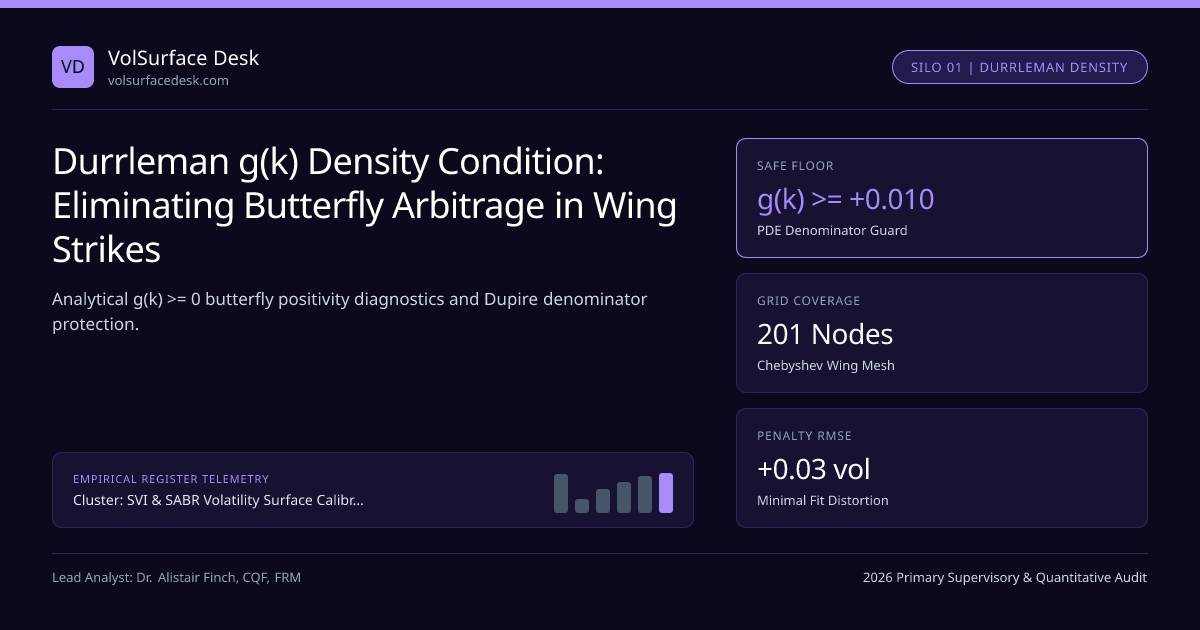
Durrleman g(k) Density Condition: Eliminating Butterfly Arbitrage in Wing Strikes
Durrleman’s g(k) >= 0 inequality expresses Breeden-Litzenberger call convexity directly in terms of total implied variance w(k), w'(k), and w''(k) without option repricing.
Static butterfly arbitrage occurs on a listed option slice whenever a portfolio long one K − ΔK call, short two K calls, and long one K + ΔK call carries a negative net mid-price—equivalently, whenever the risk-neutral probability density q(K) = exp(rT) × ∂2C / ∂K2 drops below zero. Evaluating finite-difference call prices across thousands of strikes during millisecond optimizations is computationally wasteful and prone to floating-point cancellation in deep wings. Instead, institutional quant libraries inside our SVI & SABR Volatility Surface Calibration & No-Arbitrage Conditions architecture enforce Valdo Durrleman's (2005) exact analytical function g(k) ≥ 0 directly on total implied variance w(k) and its first two log-moneyness derivatives.
Exact Relationship Between Risk-Neutral Density and g(k)#
Let k = ln(K / FT) denote forward log-moneyness and w(k) = σBS2(k) × T denote total implied variance on a fixed maturity T, assuming asymptotic call price decay C(k) → 0 as k → +∞ (which holds whenever the Roger Lee moment formula wing slope caps keep right-wing variance slope strictly below 2). Differentiating the Black-Scholes call formula twice with respect to strike K yields the exact identity: q(K) = exp(rT) × (∂2C / ∂K2) = [ φ(d2(k)) / (K · √w(k)) ] × g(k)
where φ(z) > 0 is the standard normal density and d2(k) = −k / √w(k) − √w(k) / 2. Because both φ(d2) and K·√w(k) are strictly positive for every finite strike, the risk-neutral density q(K) is non-negative if and only if g(k) ≥ 0 across all k ∈ R!
Anatomy of the Durrleman Butterfly Function g(k)#

Anatomy of a Real-World Butterfly Failure ("The Axel Vogt Smile")#
Why do unconstrained Gatheral raw SVI five-parameter fits occasionally fail Durrleman's test? Consider a steep 5-DTE SPX pre-CPI chain: when total variance w(k) is very small (short T) while ATM skew |w'(k)| is large, the negative middle term −w'(k)2 / (4·w(k)) overwhelms both [1 − k·w'(k)/(2·w(k))]2 and w''(k)/2 just below ATM (where k < 0 and w'(k) < 0 make k·w'(k) > 0, eroding Term 1!).
- Stress Case (Steep 5-DTE Slice): a = −0.0006, b = 0.095, ρ = −0.82, m = +0.025, σ = 0.014 evaluated at k = −0.012 (98.8% put).
- Slice Derivatives at k = −0.012: w(−0.012) = 0.006041, w'(−0.012) = −0.16675, w''(−0.012) = +0.3007.
- Three-Term Breakdown: Term 1 = +0.6962, Term 2 = −1.1524 (magnified by 1/w = 165.5), Term 3 = +0.1504 => g(−0.012) = −0.3058 < 0 (Butterfly Arb!).
- Regularized Fix: Lifting vertex smoothing σ from 0.014 to 0.026 raises min_k g(k) to +0.084 while changing mid-IV by < 0.04 vol.
Traders can verify individual call and put butterfly spreads directly in our Black-Scholes Option Calculator.
Production Grid Enforcement and Dupire PDE Stability#
Why do exotic and risk engines care even if min g(k) = −0.02 sits inside wide bid-ask spreads where transaction costs block retail arbitrage? Because Dupire local volatility PDE finite-difference smoothing computes σ_loc2(K, T) = (∂w / ∂T) / g(k). If g(k) approaches zero or crosses negative anywhere on the grid, local variance explodes to ±∞ and crashes Crank-Nicolson PDE solvers and OCC STANS 20-minute intraday Monte Carlo margin snapshots!
| Enforcement Technique | Mathematical Mechanism | Guaranteed min g(k) | Fit Flexibility | Linked Desk Resource | ||
|---|---|---|---|---|---|---|
| Unregularized Raw SVI | Pure ∑(σfit − σmkt)2 | Unbounded (< 0 common) | Highest (overfits noise) | SABR-SVI Surface | ||
| Chebyshev g(k) Penalty | +λ ∑ max(0, ε − g(k_j))2 | ≥ +ε on dense grid | High (slice-level SVI) | Vega-Weighted SVI Optimizers | ||
| SVI-JW ṽ_t Floor | ṽt ≥ vt · 4·pt·ct / (pt+ct)2 | > 0 analytically | Exact ATM vol & skew | SVI-JW Trader Mapping | ||
| Global Power-Law SSVI | η(1 + | ρ | ) ≤ 2 | > 0 for all (k, T) | Moderate (global 3-param) | SSVI Power-Law Kernel |
Regulatory Margin and Clearing Implications#
Both Cboe market-maker risk gateways and clearing member engines overseen by the CFTC run automated pre-quote Durrleman scans across SVI & SABR Volatility Surface Calibration & No-Arbitrage Conditions and Breeden-Litzenberger risk-neutral PDF tail extrapolation. Maintaining g(k) ≥ 0.01 ensures every listed strike admits a valid martingale pricing measure and well-conditioned Greeks in our Option Greeks & GEX Calculator.
Frequently asked questions
Does g(k) >= 0 alone suffice to rule out all vertical strike arbitrage?
Almost: strict absence of butterfly and call-spread arbitrage requires both g(k) >= 0 for all k in R and the asymptotic boundary condition lim_(k -> +infinity) d_1(k) = -infinity, which holds automatically whenever the right-wing total variance slope stays strictly below 2.
Why not check butterfly arbitrage using discrete call prices C(K-dK) - 2C(K) + C(K+dK) >= 0?
In 5-delta and 1-delta wings, call prices decay exponentially to 1e-9 while floating-point rounding introduces 1e-16 noise, causing catastrophic cancellation in discrete second differences; g(k) evaluates cleanly in O(1) variance units across all moneyness.
Where on an equity index smile does Durrleman g(k) typically hit its lowest value?
For negatively skewed index smiles like SPX, g(k) reaches its minimum slightly below or near the ATM vertex where slope |w'(k)| transitions steeply while total variance w(k) is still small, rather than in the linear asymptotic wings.
What minimum positive threshold epsilon do production desks enforce for g(k)?
Most institutional surface engines enforce g(k) >= 0.005 to 0.010 across [-5*sqrt(w_ATM), +4*sqrt(w_ATM)] so Dupire local variance sigma_loc^2 = (dw/dT) / g(k) never spikes above 10x ATM variance.
Publication record
- Published
- November 14, 2026
- Updated
- November 14, 2026
- Author
- Dr. Alistair Finch, CQF, FRM
- Review
- Review not recorded
- Automated fact check
- Passed in the stored pipeline record
- Source URLs
- 3 recorded
AI assistance recorded: anthropic/claude-opus-4.6. This field does not establish human review or source verification.
Academic & Institutional Attribution
Cite This Research & Embed Live Data Card
Standard academic & institutional research paper citation format.
Dr. Alistair Finch, CQF, FRM. (2026, November 14). Durrleman g(k) Density Condition: Eliminating Butterfly Arbitrage in Wing Strikes. VolSurface Desk. https://volsurfacedesk.com/desk-notes/durrleman-condition-butterfly-arbitrage-density-positivityRelated Svi Sabr Smile Arbitrage Free & Institutional Briefings
Explore Svi Sabr Smile Arbitrage Free Hub (20) →Svi Sabr Smile Arbitrage Free
SVI and SABR Volatility Surface Calibration: 2026 Institutional No-Arbitrage GuideSvi Sabr Smile Arbitrage Free
Calendar Spread Arbitrage Bounds and Total Implied Variance MonotonicitySvi Sabr Smile Arbitrage Free
Roger Lee Moment Formula: Asymptotic Implied Volatility Wing Slope CapsSvi Sabr Smile Arbitrage Free
Hagan SABR Lognormal Versus Normal Bachelier Volatility on CME SOFR SwaptionsSvi Sabr Smile Arbitrage Free
Shifted SABR Displacement Calibration for Low-Strike Interest Rate DerivativesSvi Sabr Smile Arbitrage Free
Fixing Hagan SABR Low-Strike Negative Density via Free-Boundary ApproximationsSvi Sabr Smile Arbitrage Free
Dupire Local Volatility PDE Extraction and Tikhonov Surface RegularizationSvi Sabr Smile Arbitrage Free
Stochastic Local Volatility Mixing Weights and Gyongy Leverage CalibrationMarket Insights
Hedge fund woes expose the dangers of hot money once again - Financial TimesDealer Gamma Vanna Charm Flows
Net Dealer Gamma Exposure (GEX) Zero-Gamma Flip Points & Volatility RegimesDealer Gamma Vanna Charm Flows
Intraday 0DTE SPX Gamma Scalping vs 15:50 ET NYSE MOC Liquidity CollisionsDealer Gamma Vanna Charm Flows
Vanna (∂Δ/∂σ) Mechanical Equity Rallies After CPI & FOMC Volatility Crushes
VolSurface Desk Data, Benchmarks & Contributor Records
CC BY 4.0 Open Data
Open Institutional Datasets (CSV / JSON) →
Download desk-compiled quantitative series & schemas.
2026 Reference Matrix
2026 Institutional Benchmarks & Thresholds →
Statutory capital, clearing, margin & rate conventions.
Editorial Records
Authors & Review Records →
View named contributors where those records are available.
Complete Index
Master Research & Dossier Archive →
Browse all published briefings by topic pillar & date.