
Vix Futures Variance Swap Convexity
VIX Futures M1–M2 Contango Roll Bleed & Curve Carry Harvesting
Calculate exact Cboe VX1–VX2 contango roll decay (~4.2% median monthly bleed), understand why long-VIX ETPs lose 45%–65% annually in calm markets, and build regime-gated VX calendar spreads.
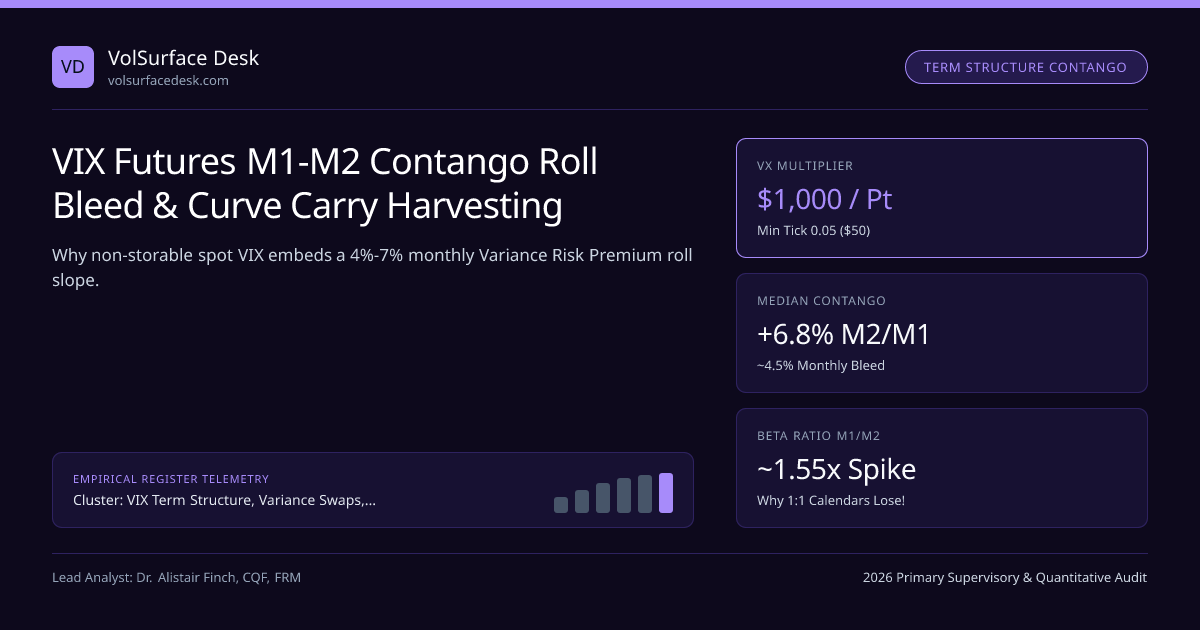
Long-volatility Exchange-Traded Products (such as VXX and UVIX) rank among the most reliable wealth-destruction vehicles in financial history when held passively—routinely suffering −45% to −75% annualized decay during multi-year equity expansions even when Spot Cboe VIX starts and ends the year at the exact same 14.00 level! Why? Because non-storable volatility futures do not obey cost-of-carry arbitrage (F ≠ S · e^(rT)). Instead, the Cboe VIX VX1–VX2 Futures Curve prices forward Variance Risk Premia, spending roughly 80% of all trading sessions in steep upward contango.
Within the VIX Term Structure, Variance Swaps, Vol-of-Vol VVIX & Tail Hedging silo and our VIX, Variance Swaps & Tail Hedging Guide, quantifying exact daily roll carry—and adjusting calendar spreads for M1/M2 beta asymmetry—is foundational for institutional volatility portfolios.
Exact Daily Roll Yield and Constant-Maturity Index Decay Math#
Consider a constant-30-day-maturity portfolio holding weight w1(t) = d1 / D in front-month VX1 (d1 business days left) and weight w2(t) = 1 − w1(t) in second-month VX2 across a D = 21 business-day settlement cycle ($1,000 CFE contract multiplier). Decomposing daily return into parallel curve shift plus deterministic roll-down carry gives:
Quantitative Pricing Model: VIX Futures M1-M2 Contango Roll Bleed & Carry Guide#
- Compound Annualized Passive Bleed (Flat Spot VIX): (1 − RollBleed_daily)^252 − 1 !
- Beta-Neutral VX Calendar Ratio: Short 1.00 × VX1 vs Long (βVX1 / βVX2) ≈ 1.45 to 1.65 × VX2 (or VX3) neutralizes moderate volatility shocks while retaining positive net roll carry!
- Worked Calm-Regime Carry Audit (Spot VIX = 13.40, VX1 [12 bus days] = 14.50, VX2 [33 bus days] = 15.85, D = 21 days):
- M1–M2 Contango = +1.35 pts (+9.31%) => Daily Roll Bleed = $1,350 / 21 = $64.29/day per contract (0.425%/day = −65.8% compounded over 252 calm days!).
Contrast this non-arbitrageable VRP slope against standard storable equity futures carry in our Futures Fair Value Calculator.
Systematic VIX Contango Carry & Regime-Gate Execution Engine#
Comparing VIX Carry & Calendar Architectures Across Crash Scenarios#
Why did unhedged short-VIX products (like XIV in February 2018) suffer 90%+ single-day wipeouts while institutional beta-weighted VX calendars + VIX call caps survived both 2020 and 2024 volatility shocks?
| VIX Term-Structure Strategy | Calm Contango Monthly Yield | P&L on Sudden Spot VIX 14 → 38 Spike | Margin & Regulatory Profile |
|---|---|---|---|
| Naked Short VX1 Future | Highest gross (+6%–9%/mo) | Catastrophic (−$20,000+/lot); uncapped jump | Heavy CFE/OCC SPAN initial margin via Apex Futures |
| Naive 1:1 Calendar (−1 VX1 / +1 VX2) | Strong (+3.5%–5%/mo) | Severe Loss (−$8,500/lot) as VX1 leaps +18 vs VX2 +9.5! | Low initial calendar margin creates false sense of safety! |
| Beta-Weighted (−2 VX1 / +3 VX2) | Moderate (+1.8%–2.8%/mo) | Near-Flat to Mild Loss up to VIX 32; loses only in 2020-scale inversion | Reduced CFE-OCC margin |
| Capped Carry (−1 VX1 / +1.4 VX2 + 40C) | Steady (+1.4%–2.2%/mo net) | Positive Tail Convexity above VIX 40 via VVIX expansion | Institutional risk-committee standard under CFTC / NFA |
Risk-Adjusted Performance of VIX Curve Carry Methodologies#
When the term-structure gate trips (VIX_spot > VX1), carry desks immediately transition to the backwardation playbook detailed next in VIX Backwardation & Spot-to-Futures Beta Regimes.
Frequently asked questions
Why doesn’t cash-and-carry arbitrage flatten VIX futures contango down to the SOFR interest rate?
Cash-and-carry requires buying the spot asset today, storing it in a vault or repo account, and delivering it into the expiring future. Because Spot VIX is a rolling 30-day variance calculation—not a storable security—no trader can "buy VIX at 13.0 and hold it for 30 days to deliver into VX1 at 15.2"!
How is the S&P 500 VIX Short-Term Futures Index daily roll calculated?
To maintain a constant 1-month maturity across a 21-business-day settlement cycle, the benchmark sells roughly 1/21st (~4.76%) of its expiring M1 (VX1) futures allocation at the daily 16:00 ET settlement and buys an equal dollar weight of M2 (VX2) futures every single afternoon.
Why is a 1-to-1 short VX1 / long VX2 calendar spread STILL dangerously exposed to crash spikes?
During a sudden equity crash, front-month VX1 jumps with ~0.80 beta to Spot VIX while second-month VX2 jumps with only ~0.52 beta! A naive 1:1 (-1 VX1 / +1 VX2) spread loses -$8,000 to -$18,000 per lot when VX1 inverts 12 points ABOVE VX2!
What term-structure filter historically avoids 75% of short-VIX carry drawdowns?
Comparing Spot VIX (or VIX9D) directly against VX1: whenever VIX_spot > VX1 (spot-to-front backwardation) or VIX9D > VIX_spot, immediate realized stress exceeds 30-day pricing—signaling systematic strategies to flatten short VX1 exposure immediately.
Publication record
- Published
- November 13, 2026
- Updated
- November 14, 2026
- Author
- Dr. Alistair Finch, CQF, FRM
- Review
- Review not recorded
- Automated fact check
- Passed in the stored pipeline record
- Source URLs
- 3 recorded
AI assistance recorded: anthropic/claude-opus-4.6. This field does not establish human review or source verification.
Academic & Institutional Attribution
Cite This Research & Embed Live Data Card
Standard academic & institutional research paper citation format.
Dr. Alistair Finch, CQF, FRM. (2026, November 14). VIX Futures M1–M2 Contango Roll Bleed & Curve Carry Harvesting. VolSurface Desk. https://volsurfacedesk.com/desk-notes/vix-vx1-vx2-contango-roll-bleed-carry-harvestingRelated Vix Futures Variance Swap Convexity & Institutional Briefings
Explore Vix Futures Variance Swap Convexity Hub (20) →Vix Futures Variance Swap Convexity
VIX Term Structure, OTC Variance Swaps, VVIX Vol-of-Vol & Tail Hedging GuideVix Futures Variance Swap Convexity
VIX Term-Structure Backwardation, Spot-to-VX Beta & Panic Mean ReversionVix Futures Variance Swap Convexity
OTC S&P 500 Variance Swaps: Vega-to-Variance Notional & Convexity MathVix Futures Variance Swap Convexity
Capped (2.5× Strike) vs Uncapped Variance Swaps: Left-Tail Gap RiskVix Futures Variance Swap Convexity
Corridor Variance & Conditional Down-Variance Swaps: Targeted Crash HedgesVix Futures Variance Swap Convexity
Cboe VVIX Vol-of-Vol & Jensen’s Inequality: The VIX Futures Convexity WedgeVix Futures Variance Swap Convexity
VIX 1×2 Call Ratios & Collars vs Direct SPX OTM Put Tail HedgesVix Futures Variance Swap Convexity
Ultra-Short VIX1D vs VIX9D, VIX & VIX3M Event Term-Structure KinksFX Risk Reversal Strangle Surfaces
FX Market Strangle (1-Vol) vs Smiley Broker Butterfly (2-Vol) IterationFX Risk Reversal Strangle Surfaces
Malz Quadratic vs Vanna-Volga FX Volatility Smile InterpolationFX Risk Reversal Strangle Surfaces
FX 10-Delta Wing Butterflies vs 25-Delta Flies: Jump Kurtosis PricingFX Risk Reversal Strangle Surfaces
Overnight FX Central-Bank Event Variance Weights (FOMC, ECB, BoJ)
VolSurface Desk Data, Benchmarks & Contributor Records
CC BY 4.0 Open Data
Open Institutional Datasets (CSV / JSON) →
Download desk-compiled quantitative series & schemas.
2026 Reference Matrix
2026 Institutional Benchmarks & Thresholds →
Statutory capital, clearing, margin & rate conventions.
Editorial Records
Authors & Review Records →
View named contributors where those records are available.
Complete Index
Master Research & Dossier Archive →
Browse all published briefings by topic pillar & date.