
Calendar Spread Arbitrage Bounds and Total Implied Variance Monotonicity
Absence of horizontal calendar spread arbitrage requires total implied variance w(k, T) to increase monotonically with maturity along constant forward log-moneyness trajectories.
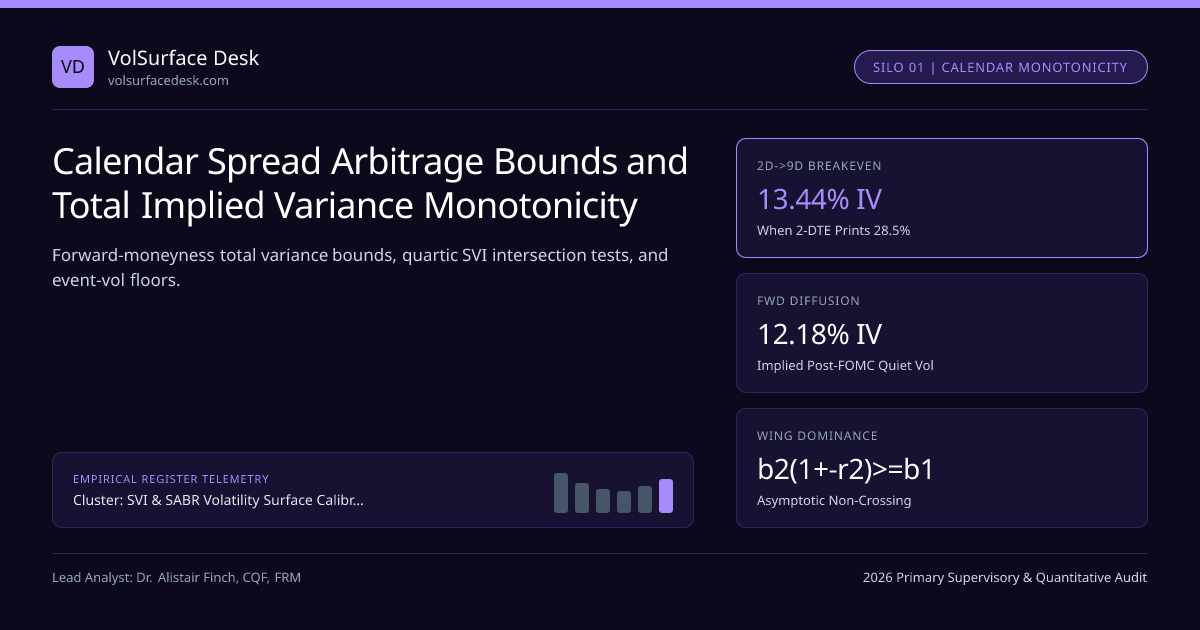
When implied volatility inverts sharply ahead of an FOMC rate decision or mega-cap earnings release—pushing 2-DTE SPX implied volatility to 28.5% while 9-DTE implied volatility trades at 17.2%—novice analysts frequently mistake steep backwardated volatility curves for calendar arbitrage. In reality, implied volatility σBS(k, T) can invert arbitrarily steeply without admitting arbitrage provided total implied variance w(k, T) = σBS2(k, T) × T remains strictly non-decreasing along constant forward log-moneyness lines k = ln(K / F_T). Inside our SVI & SABR Volatility Surface Calibration & No-Arbitrage Conditions framework, mastering exact horizontal monotonicity separates genuine event-variance backwardation on Cboe VIX1D and VIX9D benchmarks from exploitable calendar mispricings.
Why Constant Forward Moneyness—Not Constant Strike—Governs Calendar Bounds#
Suppose underlying index St carries risk-free rate r(t) and proportional dividend yield q(t), so the forward price follows FT = S0 · exp(∫0^T (ru − qu) du). Consider two expirations T1 < T2 and strikes K1, K2 chosen at identical forward moneyness K1 / FT1 = K2 / FT2 = exp(k). Because normalized Black-Scholes call value c(k, w) depends solely on (k, w) with strictly positive total-variance vega ∂c / ∂w > 0, Jensen's inequality on the martingale Mt = St / F_t forces c(k, w(k, T1)) ≤ c(k, w(k, T2)), which holds if and only if: w(k, T2) ≥ w(k, T1) for every k ∈ R and every T2 > T1.
Testing ∂w(K, T) / ∂T ≥ 0 at fixed nominal strike K when interest rates sit at 4.50% produces false-positive arbitrage alarms in steep skew wings because forward drift shifts k = ln(K / F_T) leftward by −4.5% per year!
Exact SVI Slice-Intersection & Calendar Arbitrage Audit#
Exact Algebraic Non-Crossing Test for Adjacent Raw SVI Slices#
Suppose an optimizer fits two adjacent Gatheral raw SVI slices w1(k) at T1 and w2(k) at T2. Checking 50 strikes near ATM can miss wing crossings at |k| = 0.45 where T1 has a slightly wider opening angle b1 than T2. Two necessary and exact algebraic tests catch every crossing in microseconds:
- Asymptotic Wing Dominance: As k → +∞, wi(k) ~ bi(1 + ρi)k, and as k → −∞, wi(k) ~ −bi(1 − ρi)k. Hence w2(k) ≥ w1(k) across R requires both b2(1 + ρ2) ≥ b1(1 + ρ1) and b2(1 − ρ2) ≥ b1(1 − ρ1).
- Quartic Polynomial Root Count: Squaring w2(k) − w1(k) = 0 twice eliminates both hyperbolic radicals, producing a 4th-degree polynomial P4(k) = 0 solved in closed form via Ferrari's formula or Sturm sequences. Zero real roots satisfying w2(k) = w1(k) together with w2(0) > w1(0) proves global calendar freedom!
- FOMC Week Backwardation Audit: Slice T1 = 2 trading days (2/252 = 0.007937 yr) at IV1 = 28.50%; Slice T2 = 9 trading days (0.035714 yr) at IV2 = 17.20%.
- Total Variance Comparison: w(0, T1) = 0.28502 × 0.007937 = 0.0006447; w(0, T2) = 0.17202 × 0.035714 = 0.0010566.
- Forward Diffusion Check: Δw = +0.0004119 > 0 => implied post-FOMC forward volatility σ_fwd(2D → 9D) = √(0.0004119 / 0.027778) = 12.18% (Arbitrage-Free).
- Zero-Variance Arbitrage Boundary: Calendar arbitrage triggers only if 9-DTE IV falls below √(0.0006447 / 0.035714) = 13.44%.
Traders pricing short-dated straddles around FOMC or CPI can cross-check intraday expected ranges directly in our 0DTE Expected Move Calculator and Implied Volatility Calculator.
Discrete Cash Dividends and American Exercise Nuances#
A critical trap arises in single-stock equity options when an underlying stock pays a large discrete cash dividend D at td ∈ (T1, T2). Under discrete cash dividends, stock price jumps downward by D on the ex-dividend morning, breaking proportional martingale scaling and allowing clean European call options at fixed forward moneyness to exhibit tiny localized dips unless SVI is calibrated on the pure stochastic forward component S*t = St − D·exp(−r(td − t)). That explains why institutional desks run de-Americanization under discrete cash dividends before enforcing Extended SSVI term-structure rho monotonicity.
| Calendar Scenario | Observed IV Curve | Δw(k) = w2(k) − w1(k) | Arbitrage Status | Desk Action / Instrument |
|---|---|---|---|---|
| Pre-FOMC 2D vs 9D | 28.5% → 17.2% | +0.000412 (12.18% fwd vol) | Arbitrage-Free | Price event weight in VIX1D / VIX9D |
| Over-Crushed Back Slice | 28.5% → 12.80% | −0.000060 (Negative fwd var!) | Calendar Arb | Buy 9D / Sell 2D forward-moneyness call calendar |
| Steepening Short Wing | b1(1−ρ1) = 0.062 > b2(1−ρ2) = 0.055 | Negative for k < −0.28 | Wing Calendar Arb | Clamp b2(1−ρ2) ≥ b1(1−ρ1) in optimizer |
| Normal Contango Curve | 14.2% → 16.8% | +0.001840 (17.5% fwd vol) | Arbitrage-Free | Track carry via VX1/VX2 Term Structure |
Exchange Surveillance and Quote Protection#
Automated market-making gateways at Cboe and clearing members regulated by the U.S. SEC reject mass-quote updates whenever implied forward diffusion volatility between consecutive business days falls below a 5.0% floor inside SVI & SABR Volatility Surface Calibration & No-Arbitrage Conditions, preventing stale front-week marks during post-announcement vol crushes from gifting free long-calendar convexity to latency arbitrageurs.
Frequently asked questions
Why does testing calendar spreads at fixed strike K trigger false alarms when interest rates are high?
When SOFR is 4%–5% above dividend yield, forward price F_T rises with maturity, so a fixed nominal strike K becomes progressively further out-of-the-money (lower k) at longer tenors; in negatively skewed markets, moving down-strike raises put IV or shifts call moneyness.
How low can 9-day implied volatility drop if 2-day implied volatility is 30%?
With 2 trading days at 30% IV, w_1 = 0.09 * (2/252) = 0.0007143; even if the remaining 7 days had zero variance, 9-day IV could never fall below sqrt(0.0007143 / (9/252)) = 30% * sqrt(2/9) = 14.14% without creating riskless calendar arbitrage.
Can American put options ever trade at inverted nominal prices across calendar dates without arbitrage?
No for identical nominal strikes: an American option with longer maturity T_2 always contains all exercise opportunities of T_1, so C_Amer(K, T_2) >= C_Amer(K, T_1) and P_Amer(K, T_2) >= P_Amer(K, T_1) must hold strictly at every nominal strike K.
How does Dupire local volatility react if two total variance slices touch at a single strike?
If dw(k, T)/dT hits zero at any (k, T) node, Dupire local volatility sigma_loc(K, T) = sqrt((dw/dT) / g(k)) collapses to zero, freezing local diffusion paths unless a positive forward-variance floor is enforced.
Publication record
- Published
- November 14, 2026
- Updated
- November 14, 2026
- Author
- Dr. Alistair Finch, CQF, FRM
- Review
- Review not recorded
- Automated fact check
- Passed in the stored pipeline record
- Source URLs
- 3 recorded
AI assistance recorded: anthropic/claude-opus-4.6. This field does not establish human review or source verification.
Academic & Institutional Attribution
Cite This Research & Embed Live Data Card
Standard academic & institutional research paper citation format.
Dr. Alistair Finch, CQF, FRM. (2026, November 14). Calendar Spread Arbitrage Bounds and Total Implied Variance Monotonicity. VolSurface Desk. https://volsurfacedesk.com/desk-notes/calendar-spread-arbitrage-total-variance-monotonicityRelated Svi Sabr Smile Arbitrage Free & Institutional Briefings
Explore Svi Sabr Smile Arbitrage Free Hub (20) →Svi Sabr Smile Arbitrage Free
SVI and SABR Volatility Surface Calibration: 2026 Institutional No-Arbitrage GuideSvi Sabr Smile Arbitrage Free
Roger Lee Moment Formula: Asymptotic Implied Volatility Wing Slope CapsSvi Sabr Smile Arbitrage Free
Hagan SABR Lognormal Versus Normal Bachelier Volatility on CME SOFR SwaptionsSvi Sabr Smile Arbitrage Free
Shifted SABR Displacement Calibration for Low-Strike Interest Rate DerivativesSvi Sabr Smile Arbitrage Free
Fixing Hagan SABR Low-Strike Negative Density via Free-Boundary ApproximationsSvi Sabr Smile Arbitrage Free
Dupire Local Volatility PDE Extraction and Tikhonov Surface RegularizationSvi Sabr Smile Arbitrage Free
Stochastic Local Volatility Mixing Weights and Gyongy Leverage CalibrationSvi Sabr Smile Arbitrage Free
Heston Characteristic Function FFT Pricing Versus SVI Smile InterpolationDealer Gamma Vanna Charm Flows
Net Dealer Gamma Exposure (GEX) Zero-Gamma Flip Points & Volatility RegimesDealer Gamma Vanna Charm Flows
Intraday 0DTE SPX Gamma Scalping vs 15:50 ET NYSE MOC Liquidity CollisionsDealer Gamma Vanna Charm Flows
Vanna (∂Δ/∂σ) Mechanical Equity Rallies After CPI & FOMC Volatility CrushesDealer Gamma Vanna Charm Flows
Charm (∂Δ/∂t) Time-Bleed Mechanics: Intraday, Weekend & OPEX Equity Drift
VolSurface Desk Data, Benchmarks & Contributor Records
CC BY 4.0 Open Data
Open Institutional Datasets (CSV / JSON) →
Download desk-compiled quantitative series & schemas.
2026 Reference Matrix
2026 Institutional Benchmarks & Thresholds →
Statutory capital, clearing, margin & rate conventions.
Editorial Records
Authors & Review Records →
View named contributors where those records are available.
Complete Index
Master Research & Dossier Archive →
Browse all published briefings by topic pillar & date.