
Gatheral Raw SVI Five-Parameter Total Variance Fitting on SPX Listed Options
Gatheral raw SVI fits five hyperbolic parameters to total implied variance across SPX listed options, achieving sub-0.12 vol RMSE via quasi-explicit Zeliade decomposition.
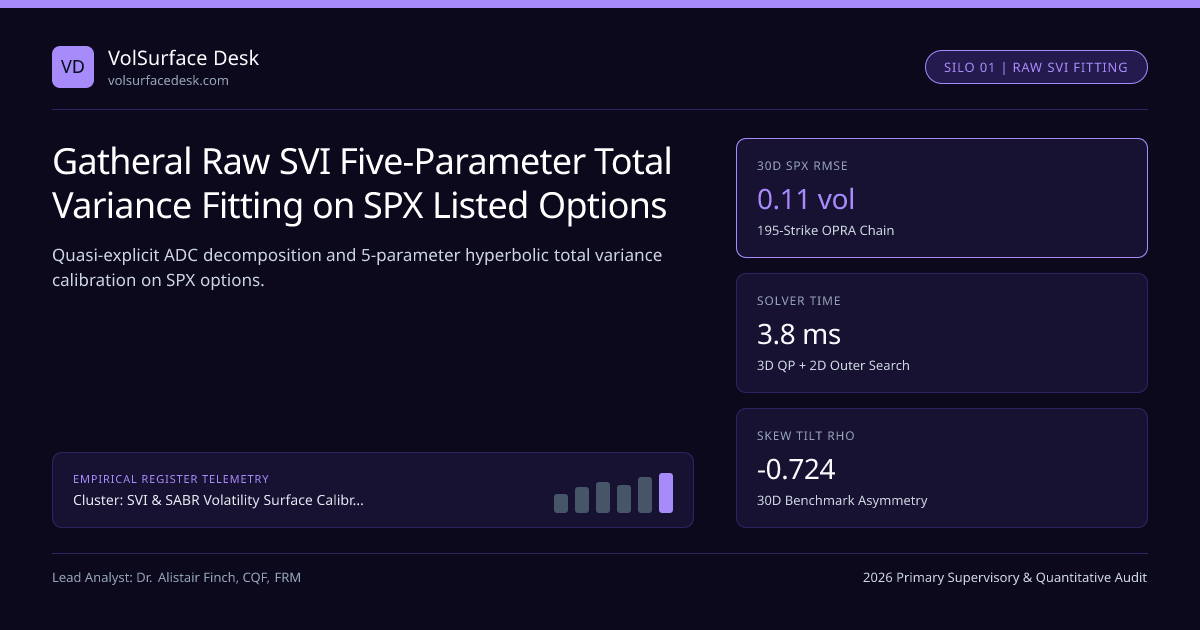
Fitting a 30-day S&P 500 option chain across 195 active strikes with Gatheral's raw Stochastic Volatility Inspired (SVI) equation reduces weighted implied volatility root-mean-square error to 0.11 vol points while preserving linear wing variance out to 2-delta crash puts. Originally introduced at Merrill Lynch in 1999 and formalized by Jim Gatheral in 2004, raw SVI writes total implied variance w(k) = σBS2(k) × T as an algebraic hyperbola over forward log-moneyness k = ln(K / FT). Within our SVI & SABR Volatility Surface Calibration & No-Arbitrage Conditions blueprint, raw SVI serves as the foundational single-slice engine benchmarked against the SABR vs Gatheral SVI surface standard.
Geometric Meaning of the Five Raw SVI Coordinates#
Every coordinate in w(k; a, b, ρ, m, σ) governs a distinct geometric transformation of the total variance smile:
- a ∈ R (Vertical Variance Shift): Moves the entire total variance hyperbola up or down; must satisfy a + bσ√(1 − ρ2) ≥ 0 so minimum variance never crosses zero.
- b ≥ 0 (Wing Opening Angle): Controls the sum of left and right asymptotic slopes, scaling overall smile kurtosis across out-of-the-money puts and calls.
- ρ ∈ (−1, 1) (Counter-Clockwise Rotation): Tilts asymmetry between downside put wings sL = −b(1 − ρ) and upside call wings sR = b(1 + ρ); SPX 30-day slices typically calibrate around ρ ∈ [−0.78, −0.62].
- m ∈ R (Horizontal Vertex Translation): Shifts the log-moneyness location where the hyperbola attains its minimum variance curvature, typically sitting +1.5% to +3.5% above the SPX forward price.
- σ > 0 (ATM Vertex Smoothing): Rounds the hyperbola apex at k = m; as σ approaches zero, raw SVI degenerates into a sharp piecewise-linear V-smile.
Quasi-Explicit Raw SVI Calibration Architecture (ADC Method)#
Solving the Non-Convex Five-Dimensional Trap via Zeliade ADC#
Naively running five-dimensional Levenberg-Marquardt directly on (a, b, ρ, m, σ) produces severe parameter collinearity between a, m, and σ: flat smiles allow σ and a to trade off inversely, causing intraday parameter jumping even when option mid-quotes move by a single tick. De Marco and Martini's quasi-explicit Zeliade reparameterization eliminates this instability by splitting the 5D problem into a convex 3D inner quadratic program nested inside a 2D outer search over (m, σ).
Setting y = (k − m) / σ, total variance becomes strictly linear in three transformed coordinates (a, d = bρσ, c = bσ):
- Convex Feasibility Domain: c ≥ 0, |d| ≤ c, c + |d| ≤ 2σ (Roger Lee upper slope cap), and a + √(c2 − d2) ≥ 0.
- Worked SPX 45-DTE Slice (F = 5,840, T = 0.1233 yr, outer vertex m = +0.022, σ = 0.080): inner QP yields a = 0.00052, d = −0.00296, c = 0.00416.
- Exact Raw SVI Recovery: b = c / σ = 0.0520; ρ = d / c = −0.7115; minimum variance wmin = 0.00344 (IVmin = 16.70%).
- Wing Moment Verification: b × (1 + |ρ|) = 0.0520 × 1.7115 = 0.0890 << 2.000 (Strictly bounded finite moments).
Empirical SPX Tenor Behavior and Desk Diagnostics#
When calibrating across Cboe SPX weekly and monthly chains, raw SVI parameters follow tight structural scaling laws. Traders convert raw outputs into human-readable skew metrics using Natural SVI and Jump-Wings parameter mapping and verify every calibrated wing against the Durrleman butterfly density positivity condition before quoting client blocks or running Greeks through our Implied Volatility Calculator and Black-Scholes Option Calculator.
| SPX Expiry Slice | a (Shift) | b (Angle) | ρ (Tilt) | m (Vertex) | σ (Smooth) | Reference Tool / Entity |
|---|---|---|---|---|---|---|
| 7-DTE Weekly | 0.00008 | 0.0285 | −0.762 | +0.009 | 0.031 | 0DTE Expected Move Tool |
| 30-DTE VIX Window | 0.00041 | 0.0440 | −0.724 | +0.018 | 0.068 | SPX 25-Delta Skew |
| 90-DTE Quarterly | 0.00145 | 0.0630 | −0.701 | +0.029 | 0.112 | Implied Vol Calculator |
| 180-DTE Semi-Annual | 0.00310 | 0.0765 | −0.689 | +0.038 | 0.154 | SABR-SVI Surface |
| 365-DTE Annual | 0.00680 | 0.0890 | −0.678 | +0.051 | 0.215 | Black-Scholes Calculator |
Guarding Against Short-Dated Butterfly Dents#
In expirations shorter than 5 trading days, heavy retail and hedge fund bidding for 10-delta SPX puts often tempts unconstrained optimizers to push b higher while shrinking σ below 0.015. Under CFTC and U.S. SEC automated market-access controls, desk risk engines impose a hard floor σ ≥ 0.018 × √(T / 0.0822) and cross-check adjacent slices inside SVI & SABR Volatility Surface Calibration & No-Arbitrage Conditions so adjacent expiries never intersect.
Frequently asked questions
Why does naive 5D Levenberg-Marquardt calibration jump erratically on raw SVI?
Parameters a and sigma exhibit strong local collinearity around the smile minimum: increasing sigma while decreasing a leaves ATM variance nearly unchanged, creating flat optimization valleys with multiple local minima that Zeliade 3D+2D splitting eliminates.
How does raw SVI parameter rho relate to Black-Scholes 25-delta risk reversals?
Negative rho rotates the total variance hyperbola counter-clockwise, steepening the downside put wing slope b*(1 - rho) while flattening the upside call wing slope b*(1 + rho), which directly widens negative 25-delta put-over-call skew.
Can raw SVI guarantee zero calendar spread arbitrage by itself?
No. Because raw SVI calibrates each expiration T independently, two non-intersecting hyperbolas in adjacent expiries can cross in deep wings unless cross-tenor monotonicity constraints or SSVI global kernels are enforced.
Where does the raw SVI vertex parameter m typically sit in equity index options?
For S&P 500 and Nasdaq-100 options, minimum implied variance sits moderately above the forward price (m between +0.01 and +0.05 log-moneyness), reflecting persistent institutional covered-call overwriting just out of the money.
Publication record
- Published
- November 14, 2026
- Updated
- November 14, 2026
- Author
- Dr. Alistair Finch, CQF, FRM
- Review
- Review not recorded
- Automated fact check
- Passed in the stored pipeline record
- Source URLs
- 3 recorded
AI assistance recorded: anthropic/claude-opus-4.6. This field does not establish human review or source verification.
Academic & Institutional Attribution
Cite This Research & Embed Live Data Card
Standard academic & institutional research paper citation format.
Dr. Alistair Finch, CQF, FRM. (2026, November 14). Gatheral Raw SVI Five-Parameter Total Variance Fitting on SPX Listed Options. VolSurface Desk. https://volsurfacedesk.com/desk-notes/gatheral-raw-svi-five-parameter-total-variance-fittingRelated Svi Sabr Smile Arbitrage Free & Institutional Briefings
Explore Svi Sabr Smile Arbitrage Free Hub (20) →Svi Sabr Smile Arbitrage Free
SVI and SABR Volatility Surface Calibration: 2026 Institutional No-Arbitrage GuideSvi Sabr Smile Arbitrage Free
Natural SVI and SVI-Jump-Wings Parameter Mapping for Equity Options DesksSvi Sabr Smile Arbitrage Free
Surface SVI Power-Law Kernel Calibration Across Multi-Expiry Index OptionsSvi Sabr Smile Arbitrage Free
Durrleman g(k) Density Condition: Eliminating Butterfly Arbitrage in Wing StrikesSvi Sabr Smile Arbitrage Free
Calendar Spread Arbitrage Bounds and Total Implied Variance MonotonicitySvi Sabr Smile Arbitrage Free
Roger Lee Moment Formula: Asymptotic Implied Volatility Wing Slope CapsSvi Sabr Smile Arbitrage Free
Hagan SABR Lognormal Versus Normal Bachelier Volatility on CME SOFR SwaptionsSvi Sabr Smile Arbitrage Free
Shifted SABR Displacement Calibration for Low-Strike Interest Rate DerivativesMarket Insights
MAGP ETF Price and Chart — CBOE:MAGP - TradingViewMarket Insights
VIX Spike: Complacency’s Bill Coming Due. What Happens Now? - Real Investment AdviceMarket Insights
Bobby Jain discusses Millennium partnership and hedge fund future, Nishant Kumar says - Traders UnionRegulatory Compliance
Andy Burnham, stop the US hedge fund takeover of Thames Water - We Own It
VolSurface Desk Data, Benchmarks & Contributor Records
CC BY 4.0 Open Data
Open Institutional Datasets (CSV / JSON) →
Download desk-compiled quantitative series & schemas.
2026 Reference Matrix
2026 Institutional Benchmarks & Thresholds →
Statutory capital, clearing, margin & rate conventions.
Editorial Records
Authors & Review Records →
View named contributors where those records are available.
Complete Index
Master Research & Dossier Archive →
Browse all published briefings by topic pillar & date.