
FX Risk Reversal Strangle Surfaces
Malz Quadratic vs Vanna-Volga FX Volatility Smile Interpolation
Graduate from Malz (1997) delta-parabola approximations to institutional Castagna-Mercurio Vanna-Volga pricing: construct exact hedging weights x1, x2, x3 across 25d Put, ATM, and 25d Call to price any FX strike without arbitrage.
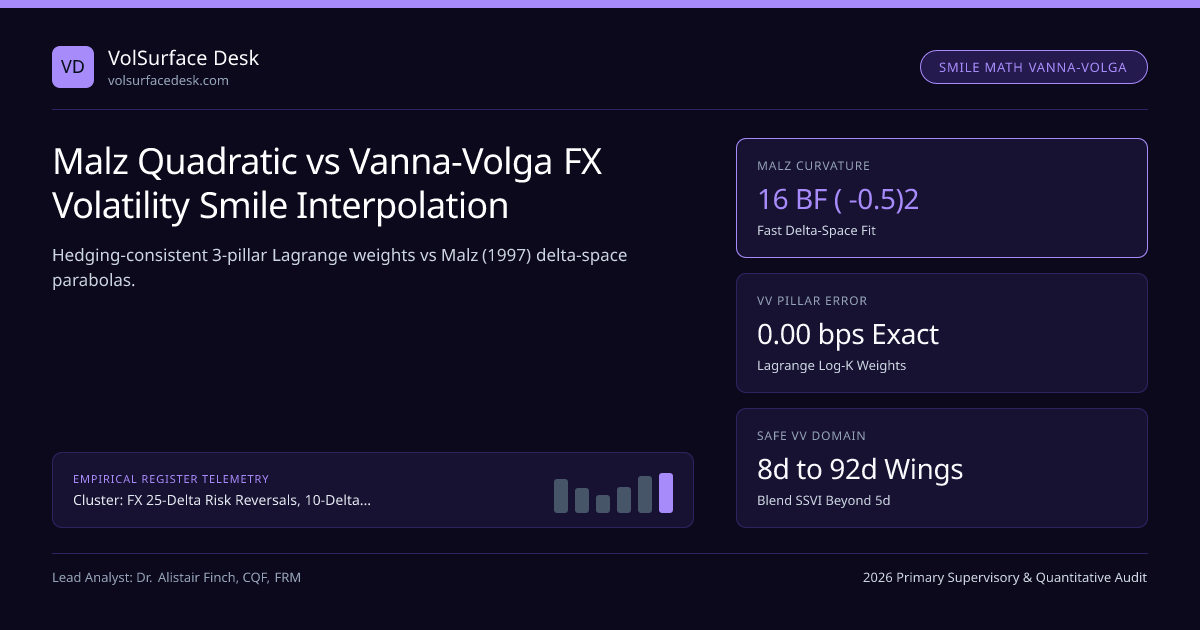
When an interbank FX market maker only observes three liquid market quotes on a 2-month tenor (K1 = K25P, K2 = KDNS, K3 = K_25C), how should they price an off-pillar corporate client request at a 14-delta call or 37-delta put? Historically, FX desks progressed from Allan Malz's (1997) delta-parabola to Castagna & Mercurio's (2007) Vanna-Volga replication—a hedging-driven smile engine that still powers tier-1 G10 FX exotic desks today.
Within the FX 25-Delta Risk Reversals, 10-Delta Butterflies & Event Vol Weights silo and our FX Volatility Surfaces & Event Vol Guide, comparing Malz, Vanna-Volga, and SABR/SVI clarifies when three-pillar replication excels and where 10-delta wings require full stochastic local volatility.
Exact Lagrange Weights of Vanna-Volga vs the Malz Delta Formula#
In Malz (1997), volatility is written directly as a parabola in signed call delta Δ ∈ (0, 1): σMalz(Δ) = σATM − 2·RR25·(Δ − 0.5) + 16·BF25·(Δ − 0.5)2 (note this is implicit in K because Δ itself depends on σ_Malz(Δ)!).
By contrast, Vanna-Volga starts from an economic no-arbitrage hedging portfolio: in a stochastic-volatility market where ATM volatility σ2 = σATM fluctuates randomly, we neutralize a target option V(K)'s Vega, Vanna, and Volga/Vomma using weights (x1, x2, x3) in the three liquid benchmark options at strikes K1 < K2 < K3. Solving that 3 × 3 Greek system at σ = σATM yields closed-form Lagrange log-moneyness weights:
Quantitative Pricing Model: Malz Quadratic vs Vanna-Volga FX Smile Interpolation Guide#
- Closed-Form Hedging Weights (i = 1,2,3; j,m ≠ i): xi(K) = [ VegaBS(K, σATM) / VegaBS(Ki, σATM) ] × [ ln(K / Kj) · ln(K / Km) ] / [ ln(Ki / Kj) · ln(Ki / Km) ] !
- Exact Pillar Recovery Check: At K = K1 (25d Put), ln(K1 / K1) makes x2(K1) = 0 and x3(K1) = 0 while x1(K1) = 1 => VVV(K1) ≡ Vmkt(K1) with ZERO error!
- Worked EUR/USD 2-Month 15-Delta Put Pricing (S = F = 1.0850, K1[25P] = 1.0662 @ 7.95%, K2[ATM] = 1.0858 @ 7.20%, K3[25C] = 1.1049 @ 7.05%, Target K[15P] = 1.0558):
- Log-Lagrange Ratios: l1(K) = +1.742, l2(K) = −0.896, l3(K) = +0.154 => Vanna-Volga Smile Cost Over BS(7.20%) = +21.8 pips => Inverted σ_VV(15P) = 8.48% vs Malz Parabola = 8.31% (−0.17v wing underpricing by Malz!).
Traders verify individual pillar Black-Scholes Vegas and option prices in our Black-Scholes Option Calculator and invert V_VV(K) back into implied volatility via the Implied Volatility Calculator.
Castagna-Mercurio Vanna-Volga 3-Pillar Pricing & Hedging Engine#
Notice Metric #1 (Only i = 1 & i = 3 active!): because σ2 = σATM, the middle pillar's market-minus-BS over-cost Vmkt(K2, σATM) − VBS(K2, σATM) is identically zero! Thus Vanna-Volga option price equals flat ATM Black-Scholes plus just **two hedge adjustments (x1 · OverCost25P + x3 · OverCost_25C)**!
Comparing Four FX Smile Interpolation Methodologies#
| Smile Model | Market Input Pillars | Hedging Interpretation | Deep Wing Behavior (< 5d) |
|---|---|---|---|
| Malz (1997) Delta Parabola | ATM, RR25, BF25 | Pure empirical polynomial in Δ | Understates jump kurtosis; flat beyond Δ → 0, 1 |
| 3-Point Vanna-Volga | 25P, ATM, 25C | Exact Vega–Vanna–Volga static hedge! | Smooth to ~8d; needs wing damping below 5d |
| 5-Point SVI / SABR | 10P, 25P, ATM, 25C, 10C | Parametric stochastic-vol asymptotics | Obeys Roger Lee linear total-variance wing slope! |
| Heston-SLV PDE | Full 5-pillar grid across all tenors | Dynamic spot + stochastic variance PDE | Gold standard for path-dependent TARFs & PRDCs |
10-Delta Wing Extrapolation Error When Calibrated Only to 25-Delta#
Look at Bar 3 (+0.36v excess kurtosis on EM 10d wings): why do emerging-market and central-bank jump currencies trade with 10-delta butterflies far richer than 25-delta Vanna-Volga predicts? That brings us directly to FX 10-Delta Wing Butterflies & Jump Kurtosis Pricing!
Frequently asked questions
Why did central banks like the Fed and Bank of England adopt the Malz (1997) smile formula?
Central-bank economists needed a simple, closed-form formula to extract risk-neutral exchange-rate probability densities from historical 3-pillar (ATM, 25d RR, 25d BF) broker archives without running iterative stochastic-volatility PDE solvers!
How does Vanna-Volga compute the exact hedging weights (x1, x2, x3) for an arbitrary strike K?
Inside a constant-σ_ATM Black-Scholes world, Vanna and Volga of any option are simple polynomials of log-moneyness ratios! Solving the 3×3 linear system matching Vega, Vanna, and Volga reduces beautifully to Lagrange interpolation polynomials in ln(K/K1), ln(K/K2), and ln(K/K3)!
Where does 3-point (25P, ATM, 25C) Vanna-Volga break down in the deep wings?
Beyond ~5-delta wings, first-order Vanna-Volga price adjustments can grow faster than Roger Lee’s √|k| asymptotic variance bound or violate Durrleman butterfly positivity if 10-delta quotes diverge sharply from 25-delta extrapolation—requiring SSVI or Heston-SLV wing Blending!
What is the difference between First-Order and Second-Order Vanna-Volga implied volatility approximations?
First-order VV divides the Vanna-Volga price over-cost by Vega(K, σ_ATM)—producing clean quadratic log-moneyness wings, though missing exact pillar recovery by a few bps. Exact Price Vanna-Volga adds the exact market-minus-BS cost of the 3 pillars and inverts Black-Scholes, hitting all 3 pillars to 0.00 bps!
Publication record
- Published
- November 13, 2026
- Updated
- November 14, 2026
- Author
- Dr. Alistair Finch, CQF, FRM
- Review
- Review not recorded
- Automated fact check
- Passed in the stored pipeline record
- Source URLs
- 3 recorded
AI assistance recorded: anthropic/claude-opus-4.6. This field does not establish human review or source verification.
Academic & Institutional Attribution
Cite This Research & Embed Live Data Card
Standard academic & institutional research paper citation format.
Dr. Alistair Finch, CQF, FRM. (2026, November 14). Malz Quadratic vs Vanna-Volga FX Volatility Smile Interpolation. VolSurface Desk. https://volsurfacedesk.com/desk-notes/malz-quadratic-vs-vanna-volga-fx-smile-interpolationRelated FX Risk Reversal Strangle Surfaces & Institutional Briefings
Explore FX Risk Reversal Strangle Surfaces Hub (20) →FX Risk Reversal Strangle Surfaces
FX Volatility Surfaces: 25-Delta Risk Reversals, 10d Butterflies & Event Vol GuideFX Risk Reversal Strangle Surfaces
FX 10-Delta Wing Butterflies vs 25-Delta Flies: Jump Kurtosis PricingFX Risk Reversal Strangle Surfaces
Overnight FX Central-Bank Event Variance Weights (FOMC, ECB, BoJ)FX Risk Reversal Strangle Surfaces
Sticky-Strike vs Sticky-Delta FX Smiles: Shadow-Delta Hedging MathFX Risk Reversal Strangle Surfaces
Vanna-Volga & First-Exit Attenuation on FX Double-No-Touch (DNT) BarriersFX Risk Reversal Strangle Surfaces
FX Reverse Knock-Out (RKO) Barriers: Discontinuous Gamma, Vanna & OverhedgesFX Risk Reversal Strangle Surfaces
New York 10:00 AM Cut vs Tokyo 3:00 PM Expiry: Intraday FX Theta ClocksFX Risk Reversal Strangle Surfaces
CME Listed FX Options (6E, 6J) vs Interbank OTC Smile Basis ArbitrageIndex Dispersion Correlation Desk
Correlation-Spike Tail Risk: Why Dispersion Books Bleed in Macro PanicsIndex Dispersion Correlation Desk
Optimal 25-Stock Proxy Baskets vs Full 500-Stock S&P 500 DispersionIndex Dispersion Correlation Desk
Execution Microstructure Drag: OPRA Bid-Ask Spreads & Delta-Hedging SlippageIndex Dispersion Correlation Desk
Implied Correlation Skew: Why 90% Put Correlation Beats 110% Calls by 25+ Pts
VolSurface Desk Data, Benchmarks & Contributor Records
CC BY 4.0 Open Data
Open Institutional Datasets (CSV / JSON) →
Download desk-compiled quantitative series & schemas.
2026 Reference Matrix
2026 Institutional Benchmarks & Thresholds →
Statutory capital, clearing, margin & rate conventions.
Editorial Records
Authors & Review Records →
View named contributors where those records are available.
Complete Index
Master Research & Dossier Archive →
Browse all published briefings by topic pillar & date.