
SVI and SABR Volatility Surface Calibration: 2026 Institutional No-Arbitrage Guide
Arbitrage-free volatility surface engines calibrate Gatheral SVI, SSVI, and Hagan SABR across listed options and swaptions while enforcing Durrleman butterfly positivity and calendar variance monotonicity.
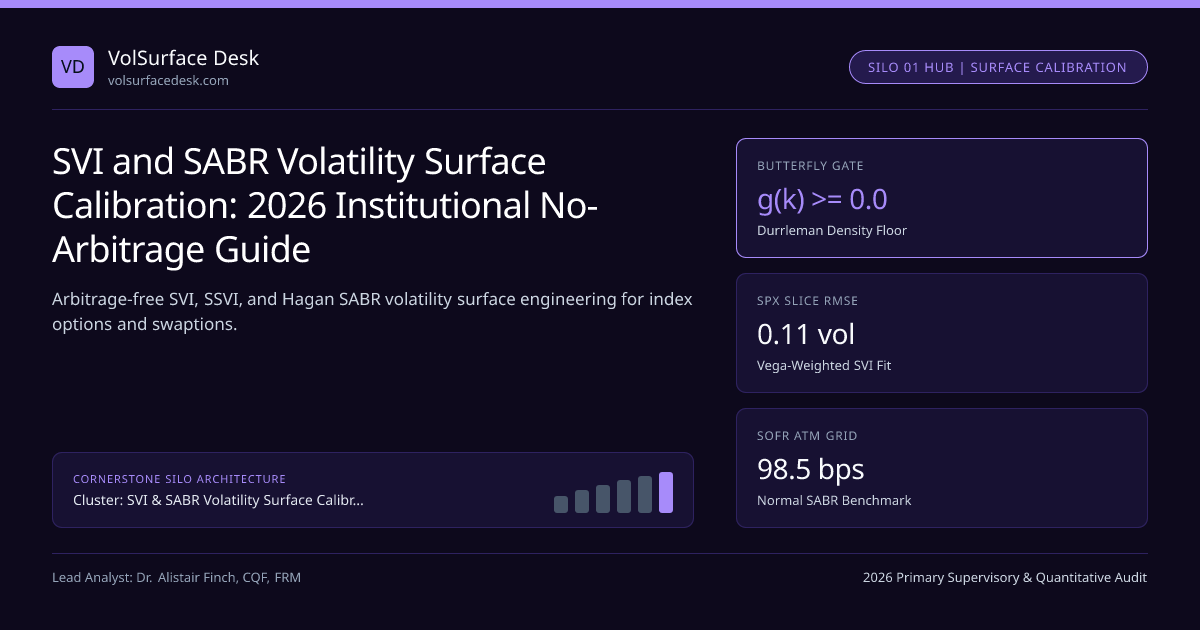
Institutional derivatives desks calibrate implied volatility surfaces across more than 14,000 active S&P 500 strikes and 420 interest rate swaption tenors every 250 milliseconds without admitting static butterfly or calendar spread arbitrage. Production fitting pipelines combine Jim Gatheral's Stochastic Volatility Inspired (SVI) parameterization for equity and index options on Cboe with Patrick Hagan's Stochastic Alpha Beta Rho (SABR) asymptotic expansion for CME SOFR swaption volatility grids. Across both asset classes, unregularized least-squares fits routinely fail in deep out-of-the-money wings when bid-ask spreads widen past 18% of mid-market option value, creating negative risk-neutral probability densities under the Breeden-Litzenberger second derivative. This cornerstone reference synthesizes the mathematical parameterizations, static no-arbitrage inequalities, forward-extraction routines, and numerical optimizers documented across the SVI & SABR Volatility Surface Calibration & No-Arbitrage Conditions hub.
Why Parametric Smile Models Replace Raw Cubic Splines#
Interpolating raw Black-Scholes implied volatilities directly across strike with unconstrained cubic splines introduces spurious inflection points between illiquid wing strikes. Because call price convexity ∂2C / ∂K2 = exp(−rT) × q(K) maps directly to the risk-neutral probability density q(K), even a 0.35-vol-point oscillation at a 5-delta SPX put strike can push q(K) below zero and trigger immediate static butterfly arbitrage alerts on automated market-making quoting engines.
Parametric families solve this structural instability by constraining asymptotic wing behavior before optimization begins. In equity and index options, Gatheral raw SVI five-parameter total variance fitting models total implied variance w(k) = σBS2(k, T) × T as a hyperbola in log-moneyness k = ln(K / FT), automatically guaranteeing linear total variance growth as |k| grows large. That linear asymptotic slope satisfies the Roger Lee moment formula wing slope caps, which require both left and right total variance slopes to remain strictly bounded by 2 so underlying asset moments stay finite. Desks preferring intuitive desk-facing Greeks translate those five coordinates via Natural SVI and Jump-Wings parameter mapping, exposing ATM variance, ATM skew, minimum variance curvature, and 25-delta put/call wing slopes directly to volatility traders who benchmark live quotes in our Implied Volatility Calculator.
Enforcing Static Butterfly and Calendar No-Arbitrage Bounds#
Fitting individual expiration slices independently is never sufficient for an institutional volatility desk pricing exotic barrier contracts, cliquets, or calendar spreads. Two distinct orthogonal no-arbitrage conditions govern any valid implied total variance surface w(k, T):
- Vertical Butterfly Positivity: Within every fixed expiration T, call prices must remain decreasing and convex in strike K. Rather than evaluating numerical finite differences across thousands of dense strike meshes, quantitative libraries evaluate the analytical Durrleman butterfly density positivity condition g(k) ≥ 0. Whenever high negative correlation ρ and steep wing curvature b compress minimum variance thickness, g(k) dips negative near the vertex, creating a classic smile W-dent that automated arbitrageurs exploit via tight zero-cost call butterflies.
- Horizontal Calendar Monotonicity: Across any fixed forward log-moneyness k = ln(K / FT), total implied variance cannot decrease with time to maturity: ∂w(k, T) / ∂T ≥ 0. Violating calendar spread total variance monotonicity implies negative forward variance between T1 and T2 when dividends are proportional. Gatheral and Jacquier's Surface SVI (SSVI) power-law kernel and Hendriks-Martini's Extended SSVI (eSSVI) rho monotonicity framework couple ATM total variance θT with an analytical backbone function φ(θ_T) so calendar crossings become algebraically impossible across the entire expiration strip.
- Variables: k = ln(K / FT) forward log-moneyness; w(k) = σBS2(k, T) × T total implied variance; (a, b, ρ, m, σ) raw SVI parameters.
- Worked SPX 30-Day Slice Check (k = 0.00 ATM, T = 0.0822 yr): set a = 0.0004, b = 0.0420, ρ = −0.720, m = 0.0150, σ = 0.0650.
- Variance & Derivatives at ATM: w(0) = 0.003655 (ATM IV = 21.09%), w'(0) = −0.03968, w''(0) = +0.5977.
- Durrleman Evaluation: g(0) = 1.0000 − 0.1078 + 0.2989 = +1.1911 > 0 (Strictly Arbitrage-Free Density).
Hagan SABR Asymptotics for Rates and Swaption Cubes#
While equity indices exhibit persistent negative skew driven by leverage and crash aversion, fixed-income caps, floors, and swaptions require joint control over backbone dynamics (β) and stochastic vol-of-vol (ν). On CME and OTC interbank desks, Hagan SABR lognormal versus normal Bachelier swaption volatilities remain the universal quoting standard under CFTC and ESMA clearing mandates.
Standard lognormal SABR fails when forward swap rates approach zero or dip negative, prompting global rates desks to adopt Shifted SABR negative-rate displacement calibration with explicit shift constants s in the 1.50% to 3.00% range. Even in positive rate regimes such as 2026 SOFR at 3.85%, Hagan's singular perturbation expansion breaks down for long-dated receiver swaptions (T ≥ 5 years, strikes 200 bps out of the money) because higher-order ν2T error terms push the implied density negative—a defect resolved through Antonov free-boundary and arbitrage-free SABR approximations. Desks can verify European Black-76 and Bachelier Greeks side-by-side in our Black-Scholes Option Calculator.

Microstructure Pre-Cleaning, Local Vol, and Dynamic Updating#
No parametric smile equation can salvage dirty input prices. Before invoking any nonlinear optimizer, institutional pipelines execute put-call parity implied forward and repo rate cleaning using our Futures Fair Value & Basis Calculator, followed by de-Americanization of single-stock equity options under discrete cash dividends so early-exercise premia do not masquerade as artificial put or call wing skew.
Once European mid-implied volatilities and bid-ask spreads are clean, vega-weighted least squares with bid-ask penalty splines fit parameters inside market width, and Kalman filter state-space intraday surface updates track live order-book shifts without full re-optimization jitter. Downstream exotic desks then feed the smooth surface into Dupire local volatility PDE finite-difference smoothing or blend it with Heston/Bergomi dynamics via Stochastic Local Volatility (SLV) Gyongy leverage mixing, while cross-checking extreme tail quantiles via Breeden-Litzenberger risk-neutral PDF tail extrapolation.
| Surface Framework | Primary Asset Class | Free Parameters | Static No-Arb Guarantee | Production Desk Tool / Benchmark |
|---|---|---|---|---|
| Gatheral Raw / JW SVI | SPX & NDX Listed Options (Cboe) | 5 per expiry slice | Analytical via g(k) ≥ 0 & Lee slope | SABR vs SVI Surface Standard |
| Surface SSVI / eSSVI | Multi-Tenor Index Volatility Grids | 3 + θ_T curve | Global butterfly & calendar bounds | Implied Volatility Calculator |
| Shifted Normal SABR | Interest Rate Swaptions & SOFR Caps | 4 (α, β, ρ, ν) + shift s | Asymptotic; Antonov fix in low wings | CME SOFR Swaptions Grid |
| Heston / Rough Bergomi | Forward-Start Cliquets & 0DTE Skew | 5 (Heston) / 3 (rBergomi) | Exact martingale measure by SDE | SPX 25-Delta Skew Benchmark |
| Dupire SLV Mixing | Exotic Barriers & Autocallables | Nonparametric L(S,t) grid | Inherits SSVI input density positivity | Option Greeks & GEX Estimator |
Regulatory Governance and Model Validation Standards#
Under U.S. SEC Rule 15c3-1e, CFTC swap dealer risk management rules (17 CFR 23.600), and BaFin / FINMA Fundamental Review of the Trading Book (FRTB) internal model standards, volatility surface parameterizations qualify as Tier-1 pricing models subject to independent daily backtesting. Validation teams audit non-modellable risk factors (NMRFs) at far-wing strikes, benchmark FFT semi-analytical engines such as Heston characteristic function Carr-Madan pricing and Rough Bergomi short-dated fractional skew models, and verify that intraday surface recalibrations never generate unexplained P&L attribution breaks exceeding 5% of daily desk vega VaR.
Frequently asked questions
Why do options desks fit total implied variance w(k) instead of Black-Scholes volatility directly?
Total variance w(k) = sigma^2 * T linearizes calendar spread no-arbitrage checks into simple monotonicity (dw/dT >= 0 at fixed forward log-moneyness) and maps directly to Roger Lee asymptotic linear wing bounds and Dupire local volatility denominators.
What is the difference between Gatheral Raw SVI and Surface SVI (SSVI)?
Raw SVI fits five independent parameters per expiration slice and needs numerical penalties to prevent calendar crossings, whereas SSVI couples all expiries through ATM total variance theta_T and an analytical kernel phi(theta_T) that guarantees global arbitrage-free coherence.
When does the standard Hagan SABR formula produce butterfly arbitrage?
Standard Hagan SABR expansions break down when nu^2 * T is large (long tenors or high vol-of-vol) and strikes approach zero or negative rates, causing the implied call price second derivative to turn negative unless Antonov or ZABR free-boundary methods are applied.
How does Stochastic Local Volatility (SLV) improve upon pure Dupire local volatility?
Pure Dupire local volatility flattens forward skew over time, mispricing forward-starting cliquets and barrier knock-outs; SLV blends stochastic vol-of-vol with a Gyongy leverage function L(S,t) so vanilla smiles and forward skew dynamics both match market quotes.
Publication record
- Published
- November 14, 2026
- Updated
- November 14, 2026
- Author
- Dr. Alistair Finch, CQF, FRM
- Review
- Review not recorded
- Automated fact check
- Passed in the stored pipeline record
- Source URLs
- 4 recorded
AI assistance recorded: anthropic/claude-opus-4.6. This field does not establish human review or source verification.
Academic & Institutional Attribution
Cite This Research & Embed Live Data Card
Standard academic & institutional research paper citation format.
Dr. Alistair Finch, CQF, FRM. (2026, November 14). SVI and SABR Volatility Surface Calibration: 2026 Institutional No-Arbitrage Guide. VolSurface Desk. https://volsurfacedesk.com/desk-notes/svi-sabr-volatility-surface-arbitrage-free-calibration-guideRelated Svi Sabr Smile Arbitrage Free & Institutional Briefings
Explore Svi Sabr Smile Arbitrage Free Hub (20) →Svi Sabr Smile Arbitrage Free
Gatheral Raw SVI Five-Parameter Total Variance Fitting on SPX Listed OptionsSvi Sabr Smile Arbitrage Free
Natural SVI and SVI-Jump-Wings Parameter Mapping for Equity Options DesksSvi Sabr Smile Arbitrage Free
Surface SVI Power-Law Kernel Calibration Across Multi-Expiry Index OptionsSvi Sabr Smile Arbitrage Free
Durrleman g(k) Density Condition: Eliminating Butterfly Arbitrage in Wing StrikesSvi Sabr Smile Arbitrage Free
Calendar Spread Arbitrage Bounds and Total Implied Variance MonotonicitySvi Sabr Smile Arbitrage Free
Roger Lee Moment Formula: Asymptotic Implied Volatility Wing Slope CapsSvi Sabr Smile Arbitrage Free
Hagan SABR Lognormal Versus Normal Bachelier Volatility on CME SOFR SwaptionsSvi Sabr Smile Arbitrage Free
Shifted SABR Displacement Calibration for Low-Strike Interest Rate DerivativesDealer Gamma Vanna Charm Flows
0DTE Index Options, Net Dealer Gamma (GEX), Vanna & Charm Rehedging Flows GuideVix Futures Variance Swap Convexity
VIX Term Structure, OTC Variance Swaps, VVIX Vol-of-Vol & Tail Hedging GuideFX Risk Reversal Strangle Surfaces
FX Volatility Surfaces: 25-Delta Risk Reversals, 10d Butterflies & Event Vol GuideIndex Dispersion Correlation Desk
Implied Correlation, Index Dispersion Baskets & Earnings Vol Crush: Desk Manual
VolSurface Desk Data, Benchmarks & Contributor Records
CC BY 4.0 Open Data
Open Institutional Datasets (CSV / JSON) →
Download desk-compiled quantitative series & schemas.
2026 Reference Matrix
2026 Institutional Benchmarks & Thresholds →
Statutory capital, clearing, margin & rate conventions.
Editorial Records
Authors & Review Records →
View named contributors where those records are available.
Complete Index
Master Research & Dossier Archive →
Browse all published briefings by topic pillar & date.