
Natural SVI and SVI-Jump-Wings Parameter Mapping for Equity Options Desks
SVI-Jump-Wings (SVI-JW) bijectively maps abstract hyperbolic coordinates into five observable trader metrics—ATM variance, ATM skew, put/call wing slopes, and minimum variance.
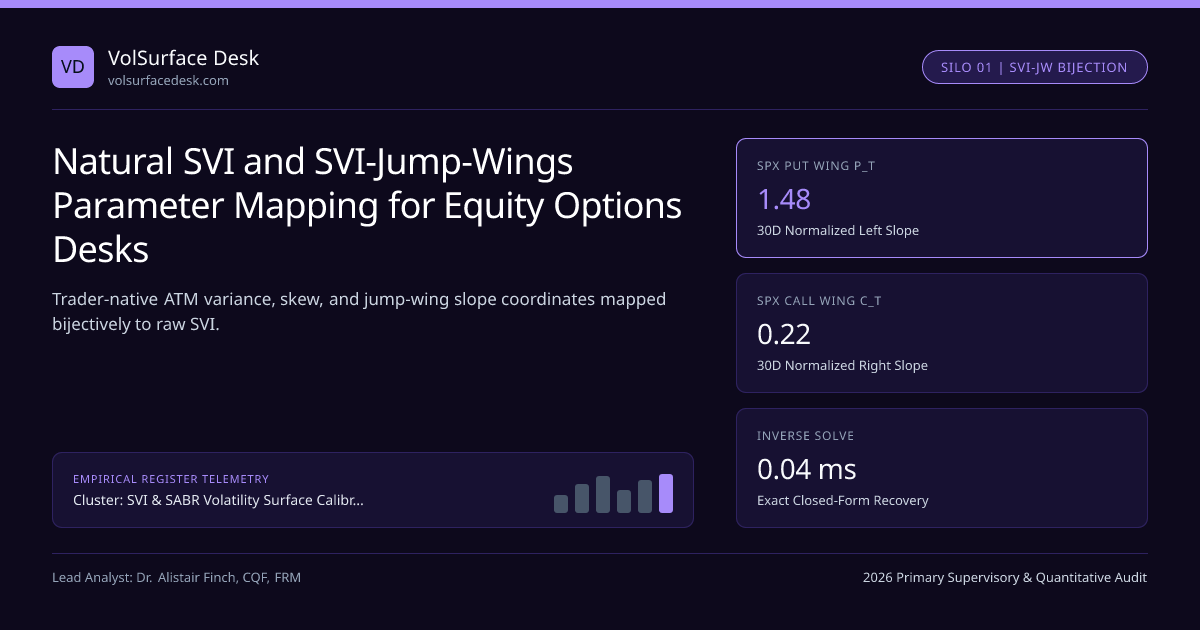
Market makers quoting single-stock and index equity options never adjust raw hyperbolic shift a or apex smoothing σ manually during live trading; instead, institutional Volatility Marking Terminals expose Gatheral's SVI-Jump-Wings (SVI-JW) coordinates (vt, ψt, pt, ct, ṽ_t), which remain time-scale invariant across expirations from 7 days to 2 years. Built as an exact mathematical bijection over Gatheral raw SVI five-parameter total variance fitting and unified within our SVI & SABR Volatility Surface Calibration & No-Arbitrage Conditions guide, Natural SVI and SVI-JW allow desk traders to bump ATM skew by +0.50 vol points per 10% moneyness without distorting ATM implied volatility.
Three Equivalent Representations of the Same Smile#
Gatheral and Jacquier (2014) established exact algebraic equivalence across three SVI coordinate systems:
- Raw SVI (a, b, ρ, m, σ): Optimal for fast Zeliade quadratic programming and analytical differentiation.
- Natural SVI (Δ, μ, ρ, ω, ζ): Centers the parameterization around ATM variance scale ω ≥ 0 and curvature ζ > 0 via w(k) = Δ + (ω / 2) × [1 + ζρ(k − μ) + √((ζ(k − μ) + ρ)2 + (1 − ρ2))], cleanly extending into Surface SVI power-law kernels when Δ = 0 and μ = 0.
- SVI-Jump-Wings (vt, ψt, pt, ct, ṽ_t): Scales every coordinate by √w(0) or 1 / T so values match annualized variance and normalized Black-Scholes volatility slopes directly observable on trading screens alongside our Implied Volatility Calculator.
Bijective Coordinate Mapping: Raw SVI <-> Natural SVI <-> SVI-JW#
Exact Bijection Equations and Inverse Recovery#
Given calibrated raw SVI parameters (a, b, ρ, m, σ) at time-to-expiry T, let w_t = w(0) denote total ATM variance. The five SVI-JW coordinates are defined analytically—and invert uniquely back to raw SVI whenever m ≠ 0:
- Inverse Map (SVI-JW -> Raw SVI): b = (√wt / 2)·(ct + pt), ρ = 1 − (pt·√wt)/b, β = ρ − (2·ψt·√w_t)/b (requires |β| ≤ 1).
- Worked NVDA 30-DTE Equity Option Slice (T = 0.0822 yr): trader marks √vt = 44.0% (wt = 0.01591), ψt = −0.38, pt = 0.92, ct = 0.48, √ṽt = 41.8%.
- Step-by-Step Recovery: b = (0.12614 / 2) × 1.40 = 0.08830; ρ = 1 − (0.92 × 0.12614)/0.08830 = −0.3143; β = −0.3143 + 1.0857 = +0.7714.
- Vertex & Shift Output: α = sign(β)·√(1/β2 − 1) = +0.8248 => m = +0.0412, σ = 0.03398, a = 0.01153 (0.04 ms exact inversion).
Notice the geometric compatibility test |β| ≤ 1: the inverse exists smoothly if and only if ATM skew ψt lies strictly between the left put wing slope −pt / 2 and right call wing slope +c_t / 2.
Cross-Sectional Stability Across Equity vs Index Names#
Why do institutional desks store historical end-of-day smile marks in SVI-JW rather than raw SVI? Across expirations, raw parameter b grows roughly as √T, making cross-tenor comparison awkward. Dividing by √wt in SVI-JW stabilizes (pt, ct, ψt) across 1-month, 3-month, and 6-month expiries so traders immediately spot term-structure kinks or Vomma wing dislocations tracked in Third-Order Greeks: Vomma, Zomma & Speed and our Option Greeks & GEX Calculator.
| Coordinate | Formula / Scale | SPX 30D Benchmark | Single-Stock Tech 30D | Desk Hedging / Risk Link |
|---|---|---|---|---|
| √v_t (ATM IV) | √(w(0) / T) | 17.80% | 38.50% | Black-Scholes Calculator |
| ψ_t (ATM Skew) | w'(0) / (2√w_t) | −0.64 | −0.26 | SPX 25-Delta Skew |
| p_t (Put Wing) | b(1 − ρ) / √w_t | 1.48 | 0.88 | SABR-SVI Surface Standard |
| c_t (Call Wing) | b(1 + ρ) / √w_t | 0.22 | 0.54 | Cboe Listed Venue |
| √ṽ_t (Min IV) | √(w_min / T) | 15.95% | 36.90% | Vomma & Zomma Mechanics |
Butterfly Safety When Manually Bumping SVI-JW Wings#
When a trader manually raises pt or ct during a market selloff on an NFA-supervised derivatives desk, raising wing slopes while holding vt − ṽt too tight can violate Durrleman butterfly positivity. Applying Gatheral-Jacquier's sufficient condition—setting vt and ψt from market ATM quotes while floor-clamping minimum variance via ṽt ≥ vt × 4·pt·ct / (pt + ct)2—provides an instant automated guardrail inside SVI & SABR Volatility Surface Calibration & No-Arbitrage Conditions before quotes hit the wire.
Frequently asked questions
What happens in the SVI-JW inverse transformation when m equals exactly zero?
When m = 0, the hyperbola minimum sits exactly at the forward (k = 0), so v_tilde_t equals v_t and ATM skew psi_t equals b*rho/(2*sqrt(w_t)); the limiting algebraic branch sets m = 0 directly and solves sigma = sqrt(w_t) / b without dividing by beta.
Why is SVI-JW preferred over 25-delta risk reversals and butterflies for equity options?
Black-Scholes delta depends on implied volatility itself, requiring iterative root-finding to map 25-delta strikes back to log-moneyness, whereas SVI-JW is defined directly at k = 0 and asymptotic |k| -> infinity with a closed-form bijection.
How does Natural SVI differ from SVI-Jump-Wings?
Natural SVI (Delta, mu, rho, omega, zeta) parameterizes total variance around the smile minimum location mu and scale omega, serving as the theoretical bridge to global Surface SVI (SSVI), whereas SVI-JW anchors directly at ATM forward k = 0 for live desk marking.
Can a desk interpolate SVI-JW coordinates linearly across adjacent option expirations?
Linearly interpolating total ATM variance w_t = v_t * T alongside bounded SVI-JW weights between adjacent slices preserves butterfly positivity much more reliably than interpolating raw SVI parameters (a, b, rho, m, sigma) directly.
Publication record
- Published
- November 14, 2026
- Updated
- November 14, 2026
- Author
- Dr. Alistair Finch, CQF, FRM
- Review
- Review not recorded
- Automated fact check
- Passed in the stored pipeline record
- Source URLs
- 3 recorded
AI assistance recorded: anthropic/claude-opus-4.6. This field does not establish human review or source verification.
Academic & Institutional Attribution
Cite This Research & Embed Live Data Card
Standard academic & institutional research paper citation format.
Dr. Alistair Finch, CQF, FRM. (2026, November 14). Natural SVI and SVI-Jump-Wings Parameter Mapping for Equity Options Desks. VolSurface Desk. https://volsurfacedesk.com/desk-notes/natural-svi-jump-wings-jw-trader-parameter-mappingRelated Svi Sabr Smile Arbitrage Free & Institutional Briefings
Explore Svi Sabr Smile Arbitrage Free Hub (20) →Svi Sabr Smile Arbitrage Free
SVI and SABR Volatility Surface Calibration: 2026 Institutional No-Arbitrage GuideSvi Sabr Smile Arbitrage Free
Surface SVI Power-Law Kernel Calibration Across Multi-Expiry Index OptionsSvi Sabr Smile Arbitrage Free
Durrleman g(k) Density Condition: Eliminating Butterfly Arbitrage in Wing StrikesSvi Sabr Smile Arbitrage Free
Calendar Spread Arbitrage Bounds and Total Implied Variance MonotonicitySvi Sabr Smile Arbitrage Free
Roger Lee Moment Formula: Asymptotic Implied Volatility Wing Slope CapsSvi Sabr Smile Arbitrage Free
Hagan SABR Lognormal Versus Normal Bachelier Volatility on CME SOFR SwaptionsSvi Sabr Smile Arbitrage Free
Shifted SABR Displacement Calibration for Low-Strike Interest Rate DerivativesSvi Sabr Smile Arbitrage Free
Fixing Hagan SABR Low-Strike Negative Density via Free-Boundary ApproximationsRegulatory Compliance
Andy Burnham, stop the US hedge fund takeover of Thames Water - We Own ItMarket Insights
Equity hedge fund losses spread in October as managers soured on U.S. tech shares - Alternatives WatchMarket Insights
Hedge fund pioneer tweaks playbook - The StarMarket Insights
Viking Hedge Fund’s ‘Holy Grail’ Metric Shows Signs of Strain - Bloomberg
VolSurface Desk Data, Benchmarks & Contributor Records
CC BY 4.0 Open Data
Open Institutional Datasets (CSV / JSON) →
Download desk-compiled quantitative series & schemas.
2026 Reference Matrix
2026 Institutional Benchmarks & Thresholds →
Statutory capital, clearing, margin & rate conventions.
Editorial Records
Authors & Review Records →
View named contributors where those records are available.
Complete Index
Master Research & Dossier Archive →
Browse all published briefings by topic pillar & date.