
Dupire Local Volatility PDE Extraction and Tikhonov Surface Regularization
Dupire’s 1994 formula recovers the unique one-factor diffusion σ_loc(K, T) matching all European option prices by dividing calendar variance growth ∂w/∂T by Durrleman’s g(k).
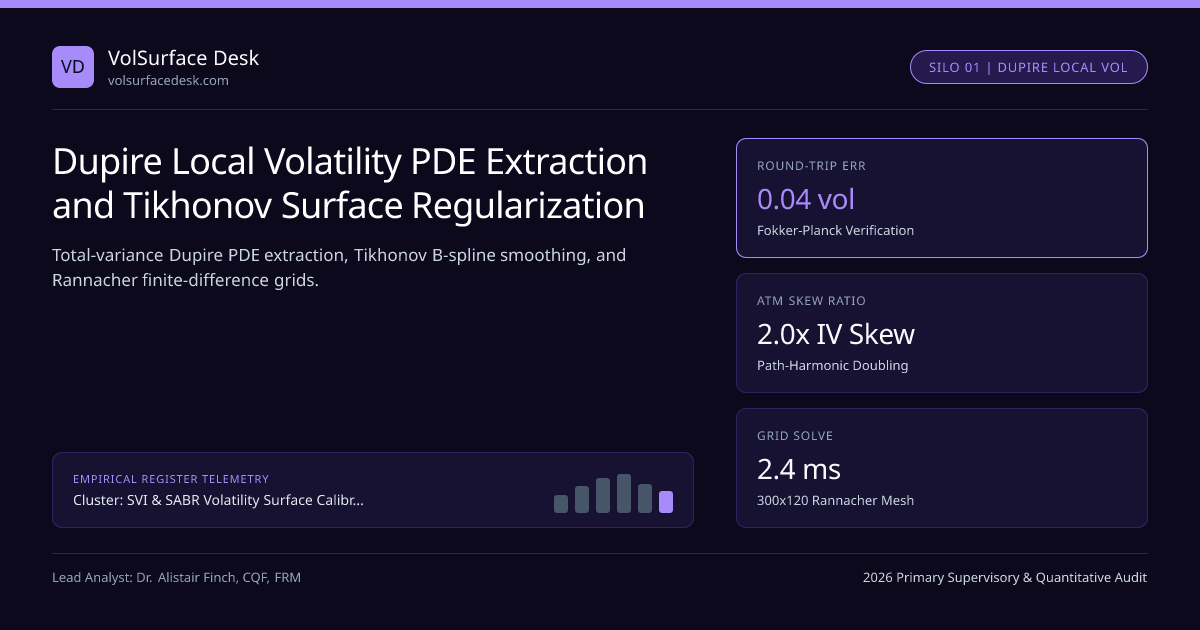
Bruno Dupire's 1994 theorem established that any arbitrage-free continuum of European call prices C(K, T) uniquely pins down a deterministic one-factor diffusion dSt / St = (rt − qt) dt + σloc(St, t) dW_t that reprices the entire vanilla option board to zero error. In raw option-price form, however, computing ∂2C / ∂K2 numerically across 5-delta strikes amplifies market bid-ask noise by 1/(ΔK)2, generating jagged spikes above 250% local volatility. Production derivatives engines inside our SVI & SABR Volatility Surface Calibration & No-Arbitrage Conditions guide evaluate Dupire directly on total implied variance w(k, T) calibrated via Surface SVI power-law kernels or Tikhonov-regularized B-splines.
Expressing Dupire in Log-Moneyness Total Variance Coordinates#
Transforming Dupire's strike-maturity PDE from call prices C(K, T) into forward log-moneyness k = ln(K / FT) and total implied variance w(k, T) = σBS2(k, T) × T eliminates explicit spot-carry partials (when expressed along constant forward moneyness) and reveals a direct structural link to the Durrleman butterfly density positivity condition:
- Numerator Condition: ∂w(k, T) / ∂T > 0 along constant forward log-moneyness enforces horizontal calendar no-arbitrage.
- Denominator Condition: g(k, T) > 0 enforces vertical Breeden-Litzenberger butterfly positivity.
- Worked SPX 60-DTE Node (k = −0.10 OTM Put, T = 0.1644 yr): ∂w/∂T = 0.0584 yr−1, w = 0.00892, w' = −0.0540, w'' = +0.2850.
- Local Variance Extraction: g(−0.10) = [1 − 0.3027]2 − (0.000729 × 112.36) + 0.1425 = 0.4862 − 0.0819 + 0.1425 = 0.5468 => σ_loc = √(0.0584 / 0.5468) = 32.68% (vs 23.29% implied vol!).
Look closely at that worked SPX downside node: when 90%-moneyness implied volatility sits at 23.29%, local volatility reaches 32.68%—nearly 9.4 vol points higher—because implied volatility averages local volatility along the most probable path from current spot S0 down to strike K (Gatheral's harmonic-mean path rule: σBS(K) ≈ [σloc(S0) + σ_loc(K)] / 2 near ATM, giving ATM local skew twice as steep as ATM implied skew!).
Production Dupire Local Volatility PDE Extraction Pipeline#
Why Rannacher Time-Stepping Beats Pure Crank-Nicolson on Barrier Payoffs#
Once σ_loc(S, t) is tabulated, exotic desks solve the backward Kolmogorov pricing PDE for barrier knock-outs, autocallables, and Asian options. Standard Crank-Nicolson time-stepping achieves O(Δt2) accuracy on smooth payoffs, but discontinuous digital or barrier payoffs trigger spurious oscillations in Gamma (∂2V / ∂S2) near the barrier strike. Replacing the first two time steps after every barrier observation or coupon date with four half-step implicit backward Euler iterations (Rannacher smoothing) damps high-frequency Fourier modes while preserving second-order convergence across Greeks cross-checked in our Black-Scholes Option Calculator and Option Greeks & GEX Calculator.
Known Forward-Skew Flattening Defect of Pure Local Vol#
Despite matching today's vanilla surface across Cboe and Eurex chains to sub-basis-point precision, pure one-factor Dupire local volatility suffers a well-known dynamic flaw: forward-starting implied volatility smiles flatten rapidly as forward start date T1 moves past 6 months. Consequently, structured equity desks never price cliquets or forward-start Napoleons on pure Dupire—instead feeding σ_loc(S, t) directly into Stochastic Local Volatility (SLV) Gyongy leverage mixing.
| Numerical Component | Naive Implementation | Institutional Desk Standard | Primary Risk Mitigated | Reference Link |
|---|---|---|---|---|
| Input Surface | Raw strike cubic spline | Tikhonov B-Spline or SSVI | Negative g(k) blowups | SABR-SVI Standard |
| Spatial Mesh | Uniform ΔS spacing | Sinh-concentrated around ATM & barrier | Pin-strike Gamma error | Option Greeks Estimator |
| Time Stepping | Pure Crank-Nicolson | Rannacher (4 Euler + Crank-Nicolson) | Digital/barrier Gamma ringing | OCC STANS Margin |
| Wing Boundary | Zero second derivative | Linear payoff ∂2V/∂S2 = 0 at ±6σ | Boundary reflection bias | ESMA Model Rules |
Independent Validation via Fokker-Planck Forward PDE#
Before releasing a new Tikhonov smoothing weight λ into production under U.S. SEC and BaFin model governance, quant validation teams inside SVI & SABR Volatility Surface Calibration & No-Arbitrage Conditions run the forward Fokker-Planck PDE forward from Dirac delta δ(S − S0) at t = 0 and verify that repriced European calls match our Implied Volatility Calculator within 0.05 vol points across 99% of open-interest-weighted strikes.
Frequently asked questions
Why is local volatility skew roughly twice as steep as implied volatility skew near ATM?
By Berestycki-Busca-Florent’s harmonic mean theorem, Black-Scholes implied volatility sigma_BS(K) equals the path-integral harmonic average of local volatility from spot S_0 to K; for linear skew near S_0, the midpoint average has half the slope of the endpoint local function.
What happens in a Dupire finite-difference solver when local volatility exceeds 200% in deep wings?
Extreme local variance violates convective-diffusive matrix conditioning and distorts transition densities; production solvers smoothly cap sigma_loc via a tanh saturate ceiling (e.g., 140%–150%) beyond the 1-delta liquid boundary.
How is the Tikhonov regularization parameter lambda selected during surface fitting?
Desks select lambda via Morozov’s discrepancy principle or generalized cross-validation: choosing the largest smoothing weight lambda such that vega-weighted option price residuals still sit inside half the observed OPRA bid-ask spread.
Does Dupire’s equation hold when interest rates are stochastic?
Under stochastic interest rates (e.g., Hull-White + Local Vol for long-dated equity autocallables), Dupire’s deterministic rate drift r_t is replaced by an expectation of instantaneous short rates conditional on terminal spot S_T = K, adding a rate-equity correlation adjustment.
Publication record
- Published
- November 14, 2026
- Updated
- November 14, 2026
- Author
- Dr. Alistair Finch, CQF, FRM
- Review
- Review not recorded
- Automated fact check
- Passed in the stored pipeline record
- Source URLs
- 3 recorded
AI assistance recorded: anthropic/claude-opus-4.6. This field does not establish human review or source verification.
Academic & Institutional Attribution
Cite This Research & Embed Live Data Card
Standard academic & institutional research paper citation format.
Dr. Alistair Finch, CQF, FRM. (2026, November 14). Dupire Local Volatility PDE Extraction and Tikhonov Surface Regularization. VolSurface Desk. https://volsurfacedesk.com/desk-notes/dupire-local-volatility-pde-finite-difference-smoothingRelated Svi Sabr Smile Arbitrage Free & Institutional Briefings
Explore Svi Sabr Smile Arbitrage Free Hub (20) →Svi Sabr Smile Arbitrage Free
SVI and SABR Volatility Surface Calibration: 2026 Institutional No-Arbitrage GuideSvi Sabr Smile Arbitrage Free
Stochastic Local Volatility Mixing Weights and Gyongy Leverage CalibrationSvi Sabr Smile Arbitrage Free
Heston Characteristic Function FFT Pricing Versus SVI Smile InterpolationSvi Sabr Smile Arbitrage Free
Rough Bergomi Hurst Exponent Scaling for Ultra-Short SPX Volatility SkewSvi Sabr Smile Arbitrage Free
De-Americanizing Single-Stock Equity Options Under Discrete Cash DividendsSvi Sabr Smile Arbitrage Free
Extracting Implied Forward and Borrow Rates Before Volatility Surface FittingSvi Sabr Smile Arbitrage Free
Vega-Weighted Least Squares and Bid-Ask Penalty Splines in SVI OptimizersSvi Sabr Smile Arbitrage Free
Extended SSVI Term-Structure Rho Monotonicity Across Quarterly Listed OptionsDealer Gamma Vanna Charm Flows
Speed (∂Γ/∂S) Third-Order Gamma Gradients & 0DTE Iron Condor Strike CliffsDealer Gamma Vanna Charm Flows
Zomma (∂Γ/∂σ) Mechanics: How Implied Volatility Shocks Mutate Dealer GammaDealer Gamma Vanna Charm Flows
Color (∂Γ/∂t) Gamma Decay vs Final-Hour 0DTE ATM Pin Risk Before 16:00 ETDealer Gamma Vanna Charm Flows
Institutional Quarterly Equity Collar Rolls (JPM HEQT) & Strike Pinning
VolSurface Desk Data, Benchmarks & Contributor Records
CC BY 4.0 Open Data
Open Institutional Datasets (CSV / JSON) →
Download desk-compiled quantitative series & schemas.
2026 Reference Matrix
2026 Institutional Benchmarks & Thresholds →
Statutory capital, clearing, margin & rate conventions.
Editorial Records
Authors & Review Records →
View named contributors where those records are available.
Complete Index
Master Research & Dossier Archive →
Browse all published briefings by topic pillar & date.