
Roger Lee Moment Formula: Asymptotic Implied Volatility Wing Slope Caps
Roger Lee’s Moment Formula proves total implied variance cannot grow faster than 2|k| in extreme wings, linking asymptotic smile slopes bijectively to critical finite asset moments.
Extrapolating polynomial volatility smiles beyond the last quoted strike on OPRA is one of the fastest ways to blow up a variance swap replication book: any quadratic or cubic polynomial in log-moneyness k = ln(K / FT) grows as |k|2 or |k|3 in extreme tails, violating no-arbitrage call bounds and implying infinite option prices. Roger Lee's landmark 2004 Moment Formula resolved wing extrapolation permanently for quantitative finance by proving that asymptotic total implied variance w(k) = σBS2(k) × T cannot grow faster than 2|k| as k → ±∞, and that its exact asymptotic slopes map one-to-one onto the highest finite positive and negative moments of the underlying martingale S_T. Inside our SVI & SABR Volatility Surface Calibration & No-Arbitrage Conditions series, Lee's theorem governs every wing constraint from Gatheral raw SVI to OTC SPX variance swap log-strips.
Exact Statement of Lee's Right-Tail and Left-Tail Theorems#
Let ST be a strictly positive risk-neutral asset price at maturity T with finite forward FT = E[ST] < ∞. Define the critical right-tail moment exponent p̃ = sup{p > 0 : E[ST^(1 + p)] < ∞} and critical left-tail moment exponent q̃ = sup{q > 0 : E[ST^(−q)] < ∞}. Define the dimensionless asymptotic total variance slopes βR = limsup(k → +∞) w(k)/|k| and βL = limsup(k → −∞) w(k)/|k|. Lee (2004) proved without any parametric model assumption that βR ∈ [0, 2] and β_L ∈ [0, 2], linked bijectively to p̃ and q̃:
- Variables: βR, βL are asymptotic slopes of w(k)/|k|; p̃ is max finite upside moment E[S^(1+p)]; q̃ is max finite inverse moment E[S^(−q)].
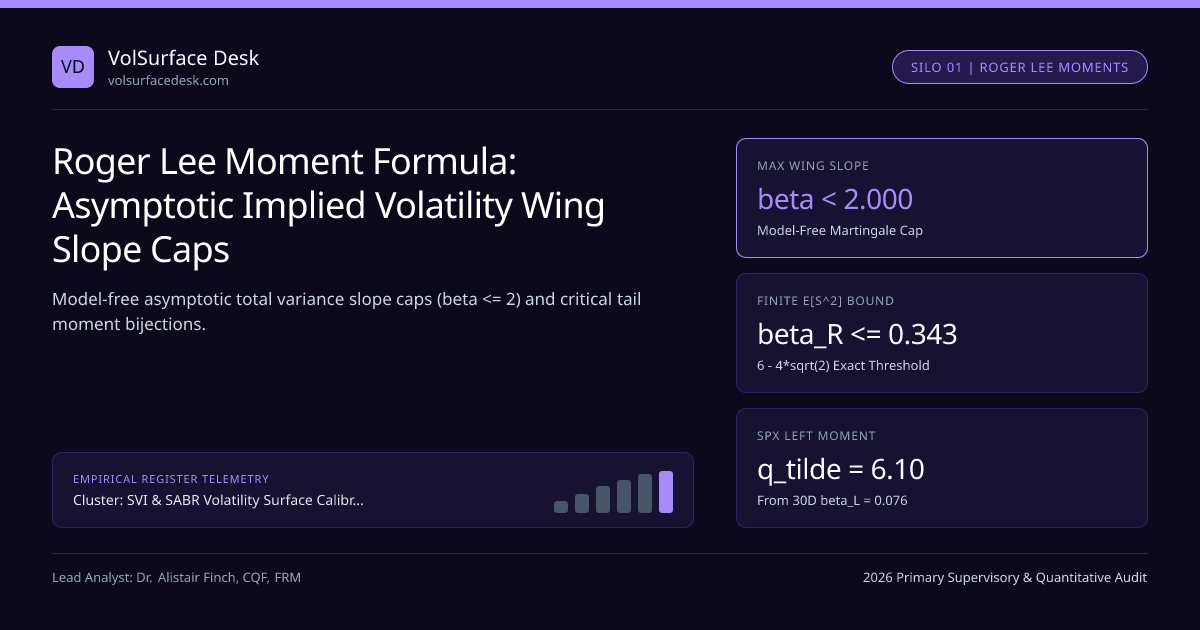
- Worked SPX 30-DTE Left Wing (b = 0.0440, ρ = −0.724): β_L = b(1 − ρ) = 0.07586 ≤ 2.0 => q̃ = 1/(0.15172) + 0.00948 − 0.5 = 6.101.
- Worked SPX 30-DTE Right Wing: β_R = b(1 + ρ) = 0.01214 ≤ 2.0 => p̃ = 41.186 + 0.0015 − 0.5 = 40.688 (thin upside vs fat downside tail).
- Second-Moment Threshold: E[ST2] < ∞ requires p̃ ≥ 1, which caps right-wing total variance slope at βR ≤ 6 − 4√2 ≈ 0.3431.
From Martingale Moment Explosion to Wing Extrapolation Policy#
Critical Thresholds Every Volatility Trader Memorizes#
Plugging integer moment benchmarks into Lee's formula reveals sharp structural regimes that desks inspect using our Implied Volatility Calculator and Cboe SKEW Index Tail Pricing:
- Pure Black-Scholes (βR = βL = 0): All positive and negative moments exist (p̃ = q̃ = ∞), producing lognormal Gaussian log-tails where variance stays flat across |k|.
- Finite Variance of Terminal Spot (E[S_T2] < ∞ ⇔ p̃ ≥ 1): Plugging p̃ = 1 yields βR = 6 − 4√2 ≈ 0.3431! Whenever an asset's right-wing total variance slope exceeds 0.3431—frequently observed in out-of-the-money Cboe VVIX VIX call options and single-stock call squeezes—the risk-neutral variance of ST itself is infinite!
- Finite Log-Contract / VIX Replication (E[|ln S_T|] < ∞): Requires q̃ > 0, i.e., strict inequality βL < 2. If βL = 2, put prices decay too slowly near K → 0 and the 1/K2 VIX variance strip diverges!
Empirical Asymptotic Wing Slopes vs Lee Theoretical Thresholds#
| Critical Moment Benchmark | Exponent (p̃ or q̃) | Exact Lee Slope Cap (β) | Implied Tail Behavior | Desk Instrument Impact |
|---|---|---|---|---|
| All Moments Finite (BSM) | ∞ | 0.0000 | Sub-exponential Gaussian log-tail | Black-Scholes Calculator |
| Finite 4th Moment E[S_T4] < ∞ | p̃ = 3.0 | 0.1443 | Bounded excess kurtosis | Standard SPX 25D Skew |
| Finite 2nd Moment E[S_T2] < ∞ | p̃ = 1.0 | 0.3431 (6 − 4√2) | Variance of terminal spot finite | Breached by VVIX OTM VIX Calls |
| Finite Inverse Spot E[S_T−1] < ∞ | q̃ = 1.0 | 0.3431 (6 − 4√2) | Quantos & FX inverse forwards finite | SABR-SVI Surface |
| Martingale No-Arb Ceiling | → 0+ | < 2.0000 | C(K) → 0 as K → ∞; P(K) ≤ K | Hard gate on Cboe & CFTC desks |
Why Polynomial and Unclamped Spline Extrapolations Fail Audits#
Model risk teams at clearinghouses supervised by the U.S. SEC and ESMA mandate linear-in-total-variance (equivalently square-root-in-log-moneyness for implied volatility σ_BS(k) ~ √(β|k| / T)) wing extrapolation outside the outer liquid 5-delta strikes. Pairing Lee's slope ceiling with Breeden-Litzenberger risk-neutral PDF tail extrapolation inside SVI & SABR Volatility Surface Calibration & No-Arbitrage Conditions guarantees well-behaved Pareto power-law tails across every stress scenario.
Frequently asked questions
Why does quadratic polynomial smile extrapolation in log-moneyness always create arbitrage?
A quadratic smile sigma(k) = c_0 + c_1*k + c_2*k^2 produces total variance w(k) ~ c_2^2 * T * k^4 for large |k|, so w(k)/|k| diverges to infinity instead of staying <= 2, causing Black-Scholes d_1 -> +infinity and call prices to increase with strike!
What happens to Black-Scholes d_1 and d_2 when total variance slope beta approaches 2?
Since d_1 = -k/sqrt(w) + sqrt(w)/2, substituting w(k) = beta * k for large positive k gives d_1 ~ (-1/sqrt(beta) + sqrt(beta)/2)*sqrt(k); if beta > 2, the coefficient turns positive, sending N(d_1) -> 1 and C(K) -> F_T instead of 0.
How does Heston stochastic volatility conform to the Roger Lee Moment Formula?
Under the Heston SDE, the moment generating function E[S_T^u] explodes at finite critical roots u_+ > 1 and u_- < 0 determined by mean reversion kappa, vol-of-vol xi, and correlation rho, so Heston total variance becomes strictly linear in |k| with exact Lee slopes.
Why does beta_R = 0.3431 matter when pricing variance swaps versus VIX futures?
For VIX options, OTM calls often exhibit beta_R > 0.3431, meaning E[VIX_T^2] under the VIX forward measure requires careful truncation or capped payoff adjustments when bridging VIX futures to SPX variance swap strikes.
Publication record
- Published
- November 14, 2026
- Updated
- November 14, 2026
- Author
- Dr. Alistair Finch, CQF, FRM
- Review
- Review not recorded
- Automated fact check
- Passed in the stored pipeline record
- Source URLs
- 3 recorded
AI assistance recorded: anthropic/claude-opus-4.6. This field does not establish human review or source verification.
Academic & Institutional Attribution
Cite This Research & Embed Live Data Card
Standard academic & institutional research paper citation format.
Dr. Alistair Finch, CQF, FRM. (2026, November 14). Roger Lee Moment Formula: Asymptotic Implied Volatility Wing Slope Caps. VolSurface Desk. https://volsurfacedesk.com/desk-notes/roger-lee-moment-formula-asymptotic-wing-slope-capsRelated Svi Sabr Smile Arbitrage Free & Institutional Briefings
Explore Svi Sabr Smile Arbitrage Free Hub (20) →Svi Sabr Smile Arbitrage Free
SVI and SABR Volatility Surface Calibration: 2026 Institutional No-Arbitrage GuideSvi Sabr Smile Arbitrage Free
Hagan SABR Lognormal Versus Normal Bachelier Volatility on CME SOFR SwaptionsSvi Sabr Smile Arbitrage Free
Shifted SABR Displacement Calibration for Low-Strike Interest Rate DerivativesSvi Sabr Smile Arbitrage Free
Fixing Hagan SABR Low-Strike Negative Density via Free-Boundary ApproximationsSvi Sabr Smile Arbitrage Free
Dupire Local Volatility PDE Extraction and Tikhonov Surface RegularizationSvi Sabr Smile Arbitrage Free
Stochastic Local Volatility Mixing Weights and Gyongy Leverage CalibrationSvi Sabr Smile Arbitrage Free
Heston Characteristic Function FFT Pricing Versus SVI Smile InterpolationSvi Sabr Smile Arbitrage Free
Rough Bergomi Hurst Exponent Scaling for Ultra-Short SPX Volatility SkewDealer Gamma Vanna Charm Flows
Intraday 0DTE SPX Gamma Scalping vs 15:50 ET NYSE MOC Liquidity CollisionsDealer Gamma Vanna Charm Flows
Vanna (∂Δ/∂σ) Mechanical Equity Rallies After CPI & FOMC Volatility CrushesDealer Gamma Vanna Charm Flows
Charm (∂Δ/∂t) Time-Bleed Mechanics: Intraday, Weekend & OPEX Equity DriftDealer Gamma Vanna Charm Flows
Vomma (Volga, ∂2V/∂σ2) Wing Convexity: Why Short 5-Delta Strangles Blow Up
VolSurface Desk Data, Benchmarks & Contributor Records
CC BY 4.0 Open Data
Open Institutional Datasets (CSV / JSON) →
Download desk-compiled quantitative series & schemas.
2026 Reference Matrix
2026 Institutional Benchmarks & Thresholds →
Statutory capital, clearing, margin & rate conventions.
Editorial Records
Authors & Review Records →
View named contributors where those records are available.
Complete Index
Master Research & Dossier Archive →
Browse all published briefings by topic pillar & date.