
Stochastic Local Volatility Mixing Weights and Gyongy Leverage Calibration
Stochastic Local Volatility (SLV) combines Heston vol-of-vol dynamics with a calibrated Gyongy leverage multiplier L(S, t) to match both vanilla smiles and exotic barrier prices.
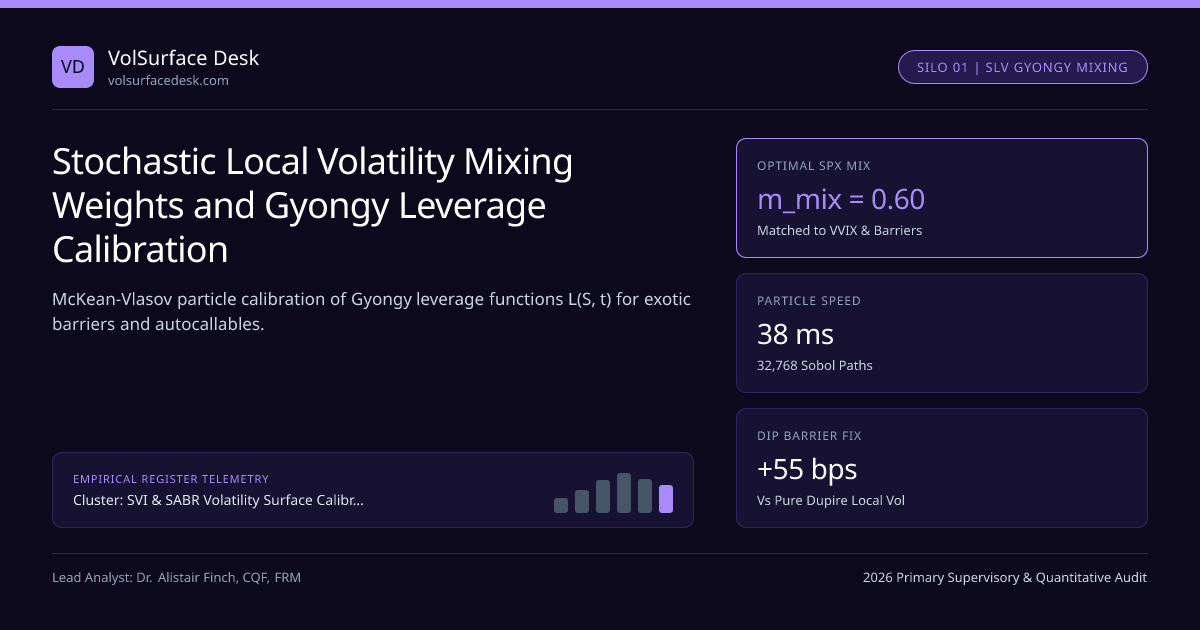
Exotic equity and FX derivatives desks face a fundamental modeling dilemma: pure stochastic volatility (Heston or SABR) captures realistic forward-skew and vol-of-vol dynamics but misses short-dated vanilla SPX option quotes by 0.80 to 1.90 vol points, whereas Dupire local volatility PDE smoothing fits every vanilla option to 0.04 vol points while underpricing barrier knock-ins and forward-start cliquets. Stochastic Local Volatility (SLV) resolves both requirements simultaneously by multiplying stochastic volatility √Vt by a deterministic leverage function L(St, t) calibrated via István Gyöngy's (1986) Markovian projection theorem. Within our SVI & SABR Volatility Surface Calibration & No-Arbitrage Conditions desk guide, SLV is the universal production workhorse for autocallables, double-no-touch barriers, and cliquets.
Gyöngy's Theorem and the Conditional Expectation Identity#
Consider an SLV diffusion under risk-neutral measure Q where spot St and variance Vt follow: dSt / St = (rt − qt) dt + L(St, t) · √Vt · dWt1, dVt = κ(θ − Vt) dt + ξm · √Vt · dWt2
Here ξm = mmix · ξ0 scales base Heston vol-of-vol ξ0 by a trader-controlled mixing fraction mmix ∈ [0, 1]. By Gyöngy's (1986) theorem, this 2D SLV process generates the exact same marginal distributions St (and therefore exact same European option prices across all K and T!) as 1D Dupire local volatility σ_loc(S, t) if and only if:
- Limiting Cases: mmix = 0 collapses Vt to deterministic θt => Pure Dupire Local Vol; mmix = 1 with L ≡ 1 => Pure Heston Stochastic Vol.
- Guyon-Henry-Labordère Particle Estimator: E[VT | ST = K] ≈ [ ∑i VT^(i) · Kh(ST^(i) − K) ] ÷ [ ∑i Kh(S_T^(i) − K) ] across N = 32,768 Sobol paths.
- Worked SPX 1-Year Down-and-In Put (Barrier B = 75% S0, Strike K = 90% S0, m_mix = 0.60 calibrated to VVIX):
- Valuation Spread: Pure Local Vol = 2.84% of notional | Pure Heston = 3.68% | 60%-Mixed SLV = 3.39% (matches interbank broker run 3.41% within 2 bps!).
Guyon-Henry-Labordère Particle SLV Calibration Engine#
Calibrating the Mixing Weight m_mix to Observable Exotics#
How does an institutional exotic desk choose mmix rather than guessing 50%? Because European vanillas are completely invariant to mmix (any mmix ∈ [0, 1] reprices the entire vanilla board identically once L(S, t) is calibrated!), mmix is uniquely identified by second-generation vol-of-vol observables:
- Equity Index Desks: Calibrate m_mix (typically 0.55 to 0.68 on SPX and SX5E) against Cboe VVIX vol-of-vol benchmarks, forward-starting variance swaps, and broker quotes on 1Y monthly-reset Napoleon cliquets.
- FX Exotic Desks: Calibrate m_mix (typically 0.50 to 0.60 on EURUSD and USDJPY) so SLV matches interbank Vanna-Volga prices on 3-month and 1-year Double-No-Touch (DNT) contracts, tracking third-order convexity in Vomma, Zomma & Speed mechanics.
Particle Method vs 2D Fokker-Planck ADI Finite Differences#
Historically, calibrating L(S, t) required iterating a 2D Alternating Direction Implicit (ADI) forward Fokker-Planck PDE for joint density p(S, V, t), taking 1.2 to 2.5 seconds per surface update. Julien Guyon and Pierre Henry-Labordère's (2012) McKean-Vlasov particle method cut calibration latency by 35× (down to 38 ms) and scaled seamlessly to 3-factor models (SLV + Hull-White stochastic interest rates) needed for 5-year autocallable notes!
| Model Choice | Vanilla SPX RMSE | Barrier / Cliquet Bias | Calibration Speed | Desk Hedging / Tool Reference |
|---|---|---|---|---|
| Pure Dupire (m_mix = 0) | 0.04 vol | −55 bps on 1Y DIP barrier | 2.4 ms (1D PDE) | Black-Scholes Calculator |
| Pure Heston (L ≡ 1) | 0.92 vol | Misses weekly vanilla hedges | 12 ms (Heston FFT) | SABR-SVI Surface |
| 2D ADI PDE SLV | 0.05 vol | < 2 bps vs broker market | 1,350 ms (2D PDE) | VVIX Vol-of-Vol |
| Particle McKean SLV | 0.06 vol | < 2 bps + supports stoch rates | 38 ms (32k Sobol) | Option Greeks & GEX Tool |
Feller Condition Pitfalls When ξ0 Is Too High#
Under FINMA, BaFin, and CFTC model risk audits, desks monitor the ratio L(S, t): if underlying Heston parameters violate Feller's condition 2κθ > ξ2 severely, a large mass of particles piles up near Vt ≈ 0, driving E[Vt | St = K] toward zero and causing L(K, t) to spike above 3.0. Keeping mmix ≈ 0.60 inside SVI & SABR Volatility Surface Calibration & No-Arbitrage Conditions keeps 2κθ > (m_mix · ξ0)2 satisfied naturally while preserving realistic Vomma and Vanna Greeks.
Frequently asked questions
Why are European vanilla option prices virtually identical for any SLV mixing fraction m_mix between 0 and 1?
By Gyongy’s (1986) theorem, matching E[L^2(S_t, t) * V_t | S_t = K] = sigma_loc^2(K, t) ensures the 1D marginal probability distribution of S_T at every maturity T matches Dupire’s surface identically, regardless of how variance splits between L and V_t.
How does changing m_mix alter delta and vega hedges on a structured autocallable book?
Higher m_mix increases correlation between spot drops and implied volatility spikes near knock-in barriers, flattening spurious local-vol gamma cliffs and shifting hedge demand from pure delta scalping toward OTM put vega.
What bandwidth h is used in the Nadaraya-Watson kernel regression during particle SLV calibration?
Production engines use Silverman’s adaptive rule-of-thumb bandwidth h = 1.06 * std(S_t) * N^(-1/5) (around 0.13 * std(S_t) for N = 32,768) combined with linear B-spline bin accumulation so each strike bin averages hundreds of particles.
Can SLV use lognormal or rough volatility processes instead of square-root Heston variance?
Yes. Many modern equity exotic desks replace CIR/Heston V_t with a two-factor lognormal Bergomi or Markovian-approximated Rough Bergomi process, completely avoiding zero-variance Feller boundary traps while improving short-dated forward skew.
Publication record
- Published
- November 14, 2026
- Updated
- November 14, 2026
- Author
- Dr. Alistair Finch, CQF, FRM
- Review
- Review not recorded
- Automated fact check
- Passed in the stored pipeline record
- Source URLs
- 3 recorded
AI assistance recorded: anthropic/claude-opus-4.6. This field does not establish human review or source verification.
Academic & Institutional Attribution
Cite This Research & Embed Live Data Card
Standard academic & institutional research paper citation format.
Dr. Alistair Finch, CQF, FRM. (2026, November 14). Stochastic Local Volatility Mixing Weights and Gyongy Leverage Calibration. VolSurface Desk. https://volsurfacedesk.com/desk-notes/stochastic-local-volatility-slv-gyongy-leverage-mixingRelated Svi Sabr Smile Arbitrage Free & Institutional Briefings
Explore Svi Sabr Smile Arbitrage Free Hub (20) →Svi Sabr Smile Arbitrage Free
SVI and SABR Volatility Surface Calibration: 2026 Institutional No-Arbitrage GuideSvi Sabr Smile Arbitrage Free
Heston Characteristic Function FFT Pricing Versus SVI Smile InterpolationSvi Sabr Smile Arbitrage Free
Rough Bergomi Hurst Exponent Scaling for Ultra-Short SPX Volatility SkewSvi Sabr Smile Arbitrage Free
De-Americanizing Single-Stock Equity Options Under Discrete Cash DividendsSvi Sabr Smile Arbitrage Free
Extracting Implied Forward and Borrow Rates Before Volatility Surface FittingSvi Sabr Smile Arbitrage Free
Vega-Weighted Least Squares and Bid-Ask Penalty Splines in SVI OptimizersSvi Sabr Smile Arbitrage Free
Extended SSVI Term-Structure Rho Monotonicity Across Quarterly Listed OptionsSvi Sabr Smile Arbitrage Free
Breeden-Litzenberger Risk-Neutral Density Recovery and Pareto Wing TailsDealer Gamma Vanna Charm Flows
Zomma (∂Γ/∂σ) Mechanics: How Implied Volatility Shocks Mutate Dealer GammaDealer Gamma Vanna Charm Flows
Color (∂Γ/∂t) Gamma Decay vs Final-Hour 0DTE ATM Pin Risk Before 16:00 ETDealer Gamma Vanna Charm Flows
Institutional Quarterly Equity Collar Rolls (JPM HEQT) & Strike PinningDealer Gamma Vanna Charm Flows
Nasdaq-100 (NDX & QQQ) vs S&P 500 (SPX) 0DTE Gamma Pinning & Vol Spreads
VolSurface Desk Data, Benchmarks & Contributor Records
CC BY 4.0 Open Data
Open Institutional Datasets (CSV / JSON) →
Download desk-compiled quantitative series & schemas.
2026 Reference Matrix
2026 Institutional Benchmarks & Thresholds →
Statutory capital, clearing, margin & rate conventions.
Editorial Records
Authors & Review Records →
View named contributors where those records are available.
Complete Index
Master Research & Dossier Archive →
Browse all published briefings by topic pillar & date.