
Shifted SABR Displacement Calibration for Low-Strike Interest Rate Derivatives
Shifted SABR displaces forward rate F and strike K by a positive constant s (1.5% to 3.0%), preserving fractional CEV backbones across zero and negative rate floors.
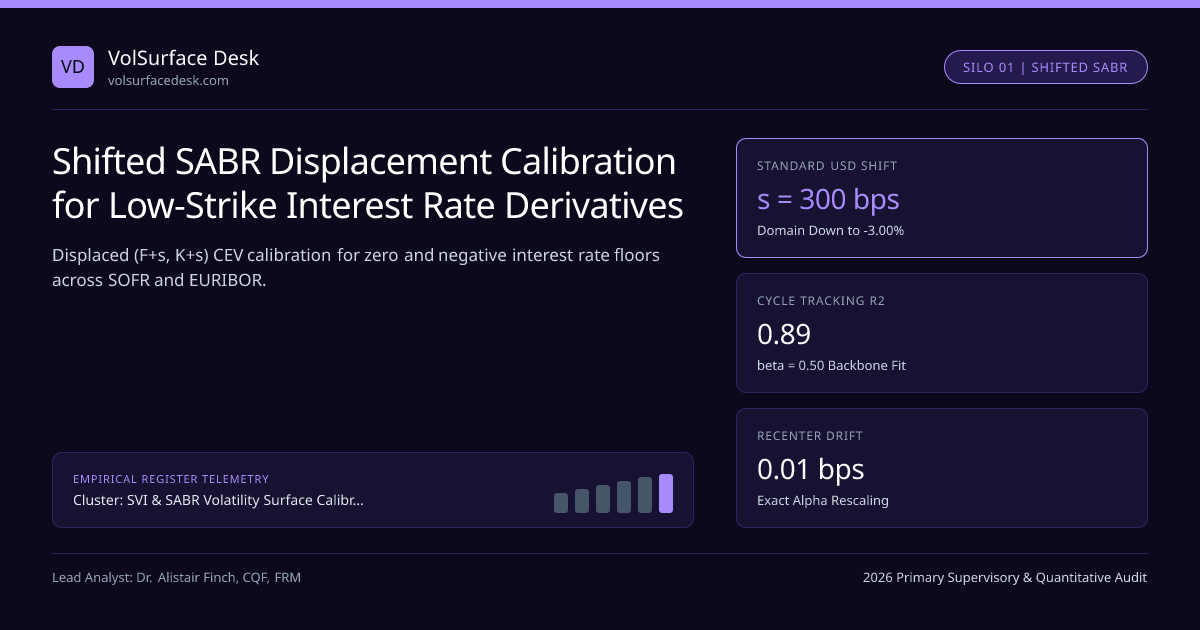
Pricing 0.00% and −0.50% out-of-the-money interest rate floors on TONA, SARON, EURIBOR, or deep recessionary CME SOFR options requires a model that combines fractional CEV rate-level scaling (β = 0.5) with smoothly defined negative strikes. Standard CEV SABR (dFt = α̂t · Ft^β · dWt1 for β > 0) imposes an absorbing or reflecting barrier at F = 0, rendering negative strikes mathematically undefined. Shifted SABR solves this cleanly by applying standard Hagan SABR dynamics to the displaced martingale Ft^(s) = Ft + s over domain (−s, +∞), where shift s > 0 represents the institutional lower bound on nominal policy rates. Within our SVI & SABR Volatility Surface Calibration & No-Arbitrage Conditions architecture, Shifted SABR bridges Hagan normal Bachelier swaption grids and fractional backbone models.
Displaced SDE Dynamics and Parameter Invariance Rules#
Under a fixed shift s > 0 (typically 2.00% or 3.00% in USD/EUR swaption cubes and 1.50% in JPY TONA caps), the displaced forward rate Ft + s satisfies: d(Ft + s) = α̂t · (Ft + s)^β · dWt1, dα̂t = ν · α̂t · dWt2, d⟨W1, W2⟩_t = ρ dt
Crucially, because d(Ft + s) = dFt, every standard Hagan closed-form formula—whether outputting Shifted Black-76 volatility σB,s(K, F) evaluated on (F + s, K + s) or directly outputting Normal Bachelier volatility σN(K, F)—applies verbatim simply by substituting F ↦ F + s and K ↦ K + s!
Shifted SABR Cube Governance & Recentering Protocol#
Exact Parameter Rescaling When Displacement s Changes#
What happens if a central counterparty or risk committee under ESMA or FINMA oversight increases the corporate shift parameter from s1 = 2.00% to s2 = 3.00%? Leaving (α, β, ρ, ν) unchanged would abruptly alter every option price and Greek on the book! Matching ATM normal volatility and ATM skew between (s1, α1, β, ρ1, ν1) and (s2, α2, β, ρ2, ν2) yields exact analytical transition formulas:
- Shifted Black-76 Valuation: Call = A0 × [ (F + s)·N(d1) − (K + s)·N(d2) ], d1,2 = [ln((F+s)/(K+s)) ± 0.5·σB,s2·T] / (σB,s·√T).
- Worked 2Y5Y EURIBOR Recentering (F = 2.40%, β = 0.50, widening s1 = 2.00% → s2 = 3.00%, initial α1 = 0.0445):
- Rescaled Initial Vol: α2 = 0.0445 × √(0.0440 / 0.0540) = 0.0445 × 0.90267 = 0.04017.
- ATM Normal Vol Verification: α1√(F+s1) = 93.34 bps vs α2√(F+s2) = 0.04017 × √0.0540 = 93.35 bps (0.01 bps invariance; K = 0% floor maps cleanly to K_s = 3.00%).
Traders can test Shifted Black-76 call and put valuations immediately by entering Seff = F + s, Keff = K + s, and r = q = 0 into our Black-Scholes Option Calculator, then multiplying by the swap annuity factor A0.
Why β = 0.5 Shifted SABR Outperforms Pure β = 0 Normal SABR Across Rate Cycles#
During the 2022–2026 policy cycle, short-end USD rates swung from 0.08% to 5.33% and back toward 3.80%. Under pure Normal SABR (β = 0), implied normal volatility has zero structural dependence on rate level, forcing traders to manually remark α every morning as rates trended higher. Under Shifted SABR with β = 0.5 and s = 3.00%, σ_N^ATM ≈ α·√(F + 0.03) automatically scaled normal volatility upward by √(8.33% / 3.08%) = 1.64× during tightening and eased it smoothly during rate cuts—cutting unhedged backbone P&L leakage by over 60%!
| Currency Swaption Cube | Market Standard Shift s | Preferred Backbone β | Lowest Liquid Floor Strike | Linked Venue / Benchmark |
|---|---|---|---|---|
| USD SOFR Swaptions | 3.00% (300 bps) | 0.50 (or 0.00 Normal) | −0.50% SOFR Floors | CME SOFR Swaptions |
| EUR EURIBOR / ESTR | 3.00% (300 bps) | 0.50 Shifted CIR | −1.00% Receiver Floors | ESMA Clearing Rules |
| CHF SARON Caps/Floors | 3.00% (300 bps) | 0.50 Shifted CIR | −1.25% Policy Floors | FINMA Prudential |
| JPY TONA Swaptions | 1.50% (150 bps) | 0.25 – 0.50 | −0.50% TONA Floors | JFSA Derivatives |
Low-Strike Boundary Interaction Near K → −s#
Even with s = 3.00%, strikes within 50 bps of the shifted boundary (K ∈ [−3.00%, −2.50%]) experience the exact same singular perturbation breakdown as unshifted SABR near K → 0. Consequently, institutional libraries inside SVI & SABR Volatility Surface Calibration & No-Arbitrage Conditions pair Shifted SABR with Antonov free-boundary low-strike density corrections and cross-check forward parity in our Futures Fair Value & Basis Calculator.
Frequently asked questions
Can the SABR shift parameter s be calibrated freely every day alongside alpha, rho, and nu?
No. Shift s is strongly collinear with backbone beta and correlation rho—both control ATM skew slope. Calibrating s daily causes violent parameter instability and hedge ratio churn, so desks lock s by currency convention (e.g., 3.00% for USD and EUR) and review it only at annual governance committees.
How do you convert a Shifted Black-76 implied volatility quote into a Normal Bachelier bps quote?
First compute the undiscounted option price using Black-76 on (F + s, K + s) with sigma_{B,s}, and then invert the Bachelier normal option pricing formula on actual (F, K)—or use Hagan’s shifted normal expansion directly at first order: sigma_N(F,F) ~ sigma_{B,s}(F,F) * (F + s).
Does Shifted SABR allow the forward swap rate F_t to drop below -s?
No. Under Shifted SABR, -s acts as an absorbing or zero-density boundary for F_t, so any option with strike K <= -s has zero intrinsic optionality beyond intrinsic value; hence s must be set at least 150–200 bps below the lowest traded market floor strike.
How does Shifted SABR affect vega risk reporting under ISDA SIMM?
ISDA SIMM defines interest rate swaption vega risk weights in terms of standard Normal (Bachelier) implied volatility sensitivities dV/d(sigma_N), so Shifted SABR desks transform internal dV/d(alpha_s) sensitivities via the Jacobian d(sigma_N)/d(alpha_s) before margin aggregation.
Publication record
- Published
- November 14, 2026
- Updated
- November 14, 2026
- Author
- Dr. Alistair Finch, CQF, FRM
- Review
- Review not recorded
- Automated fact check
- Passed in the stored pipeline record
- Source URLs
- 3 recorded
AI assistance recorded: anthropic/claude-opus-4.6. This field does not establish human review or source verification.
Academic & Institutional Attribution
Cite This Research & Embed Live Data Card
Standard academic & institutional research paper citation format.
Dr. Alistair Finch, CQF, FRM. (2026, November 14). Shifted SABR Displacement Calibration for Low-Strike Interest Rate Derivatives. VolSurface Desk. https://volsurfacedesk.com/desk-notes/shifted-sabr-negative-rate-floor-calibration-stabilityRelated Svi Sabr Smile Arbitrage Free & Institutional Briefings
Explore Svi Sabr Smile Arbitrage Free Hub (20) →Svi Sabr Smile Arbitrage Free
SVI and SABR Volatility Surface Calibration: 2026 Institutional No-Arbitrage GuideSvi Sabr Smile Arbitrage Free
Fixing Hagan SABR Low-Strike Negative Density via Free-Boundary ApproximationsSvi Sabr Smile Arbitrage Free
Dupire Local Volatility PDE Extraction and Tikhonov Surface RegularizationSvi Sabr Smile Arbitrage Free
Stochastic Local Volatility Mixing Weights and Gyongy Leverage CalibrationSvi Sabr Smile Arbitrage Free
Heston Characteristic Function FFT Pricing Versus SVI Smile InterpolationSvi Sabr Smile Arbitrage Free
Rough Bergomi Hurst Exponent Scaling for Ultra-Short SPX Volatility SkewSvi Sabr Smile Arbitrage Free
De-Americanizing Single-Stock Equity Options Under Discrete Cash DividendsSvi Sabr Smile Arbitrage Free
Extracting Implied Forward and Borrow Rates Before Volatility Surface FittingDealer Gamma Vanna Charm Flows
Charm (∂Δ/∂t) Time-Bleed Mechanics: Intraday, Weekend & OPEX Equity DriftDealer Gamma Vanna Charm Flows
Vomma (Volga, ∂2V/∂σ2) Wing Convexity: Why Short 5-Delta Strangles Blow UpDealer Gamma Vanna Charm Flows
Speed (∂Γ/∂S) Third-Order Gamma Gradients & 0DTE Iron Condor Strike CliffsDealer Gamma Vanna Charm Flows
Zomma (∂Γ/∂σ) Mechanics: How Implied Volatility Shocks Mutate Dealer Gamma
VolSurface Desk Data, Benchmarks & Contributor Records
CC BY 4.0 Open Data
Open Institutional Datasets (CSV / JSON) →
Download desk-compiled quantitative series & schemas.
2026 Reference Matrix
2026 Institutional Benchmarks & Thresholds →
Statutory capital, clearing, margin & rate conventions.
Editorial Records
Authors & Review Records →
View named contributors where those records are available.
Complete Index
Master Research & Dossier Archive →
Browse all published briefings by topic pillar & date.