
Hagan SABR Lognormal Versus Normal Bachelier Volatility on CME SOFR Swaptions
CME SOFR options and USD interest rate swaption desks quote Normal Bachelier bps volatility calibrated via Hagan’s stochastic alpha-beta-rho (SABR) expansion.
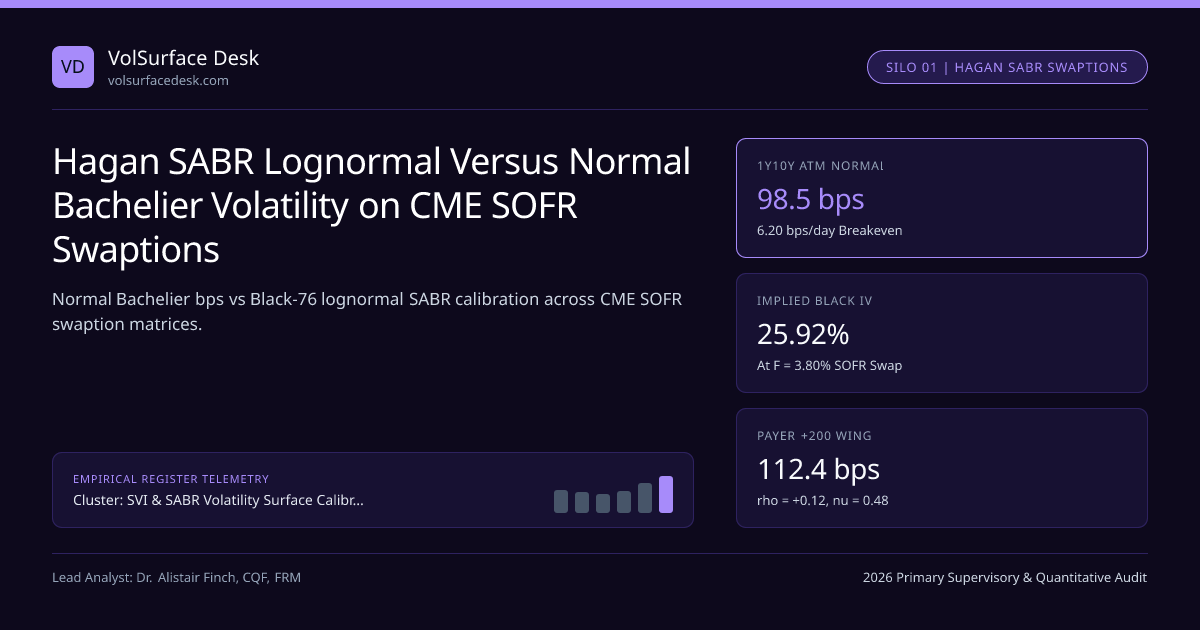
Global USD and EUR interest rate derivatives desks quote swaption matrices and CME SOFR options in annualized normal (Bachelier) basis points—such as 98.5 bps/yr on 1Y10Y SOFR swaptions—rather than percentage Black-76 lognormal implied volatility. Patrick Hagan, Deep Kumar, Andrew Lesniewski, and Diana Woodward's (2002) Stochastic Alpha Beta Rho (SABR) singular perturbation formulas provide closed-form asymptotic expansions for both Black-76 lognormal volatility σB(K, F) and Bachelier normal volatility σN(K, F) from the same underlying stochastic differential equation. Within our SVI & SABR Volatility Surface Calibration & No-Arbitrage Conditions desk guide, reconciling SABR normal and lognormal dynamics is mandatory for hedging rate caps, floors, and swaption cubes.
The SABR Stochastic Differential Equation and Backbone β#
Under the T-forward annuity measure, forward swap rate Ft and stochastic volatility α̂t evolve with zero drift: dFt = α̂t · Ft^β · dWt1, dα̂t = ν · α̂t · dWt2, d⟨W1, W2⟩t = ρ dt
with initial volatility α̂0 = α > 0, CEV backbone exponent β ∈ [0, 1], spot-vol correlation ρ ∈ [−1, 1], and vol-of-vol ν ≥ 0. Fixing β prior to calibration reflects how ATM normal volatility moves when rates shift:
- Normal SABR (β = 0): dFt = α̂t dW_t1; ATM normal bps vol stays nearly flat as SOFR moves, making β = 0 (or β = 0.25) the dominant convention on CME Group and interbank USD/EUR swaption desks.
- CIR / Square-Root Backbone (β = 0.5): Balances rate-level scaling without lognormal zero-rate singularities, popular alongside Shifted SABR displacement calibration.
- Lognormal SABR (β = 1): dFt = α̂t Ft dWt1; natural for FX and commodity forwards where percentage vol is scale-invariant.
CME SOFR Swaption Cube SABR Calibration & Bachelier Workflow#
Exact Hagan Normal (Bachelier) vs Black-76 Asymptotic Formulas#
For pure Normal SABR (β = 0), Hagan's Bachelier normal implied volatility σ_N(K, F) simplifies dramatically compared to the fractional-power lognormal formula, eliminating F^(1−β) singularities entirely:
- Geodesic Function: x(u) = ln( [ √(1 − 2ρu + u2) + u − ρ ] / (1 − ρ) ); at ATM (u → 0), u / x(u) = 1.
- Worked 1Y10Y USD SOFR Swaption (F = 3.80%, T = 1.0 yr, ATM σ_N = 98.5 bps, ρ = +0.12, ν = 0.48, β = 0):
- Calibrated Initial Vol: Time factor = 1 + [(2 − 0.0432)/24] × 0.2304 = 1.01878 => α = 98.5 / 1.01878 = 96.68 bps.
- +100 bps OTM Payer (K = 4.80%): u = +0.4965, x(u) = +0.4718 => σ_N(4.80%) = 96.68 × (0.4965/0.4718) × 1.01878 = 103.65 bps (Black ATM IV ≈ 98.5 / 380 = 25.92%).
Desks convert seamlessly between Black-76 prices and implied volatilities using our Black-Scholes Option Calculator and Implied Volatility Calculator.
Shadow Delta Correction Under Sticky SABR Parameters#
One of SABR's primary advantages over static polynomial interpolation is consistent delta hedging. Under SABR, moving forward swap rate F shifts implied volatility along the backbone and smile simultaneously: ΔSABR = ∂VN / ∂F + (∂VN / ∂σN) × [ ∂σN / ∂F + (∂σN / ∂α) · (ρν / F^β) ]
Ignoring Bartlett's (2006) ρν / F^β cross-correlation vanna correction leaves rates swaption books systematically under-hedged or over-hedged by 4% to 9% of notional delta during Federal Reserve repricing shocks.
| Swaption Tenor | Forward SOFR Rate | ATM Normal Vol | SABR (β, ρ, ν) | Implied Black-76 ATM IV | Benchmark / Regulator |
|---|---|---|---|---|---|
| 3M2Y Front-End | 3.95% | 114.0 bps | (0.0, −0.08, 0.62) | 28.86% | CME SOFR Grid |
| 1Y5Y Belly | 3.76% | 104.2 bps | (0.0, +0.05, 0.51) | 27.71% | SOFR 2026 Standard |
| 1Y10Y Benchmark | 3.80% | 98.5 bps | (0.0, +0.12, 0.48) | 25.92% | CFTC Swap Rules |
| 5Y10Y Forward | 3.92% | 86.4 bps | (0.0, +0.18, 0.36) | 22.04% | ESMA Clearing |
| 10Y30Y Long-End | 3.88% | 78.0 bps | (0.0, +0.21, 0.31) | 20.10% | Antonov Low-Strike Fix |
Guarding Against Long-Tenor Wing Breakdown#
For 5Y10Y and 10Y30Y swaptions where ν2T exceeds 0.45, Hagan's first-order time expansion loses accuracy at strikes below 1.00%, motivating desks across SVI & SABR Volatility Surface Calibration & No-Arbitrage Conditions to pair Normal SABR with Antonov free-boundary density fixes when valuing CMS spread options and Bermudan callable bonds.
Frequently asked questions
Why did global interest rate swaption desks switch from Black-76 percentage vol to Normal Bachelier bps vol?
When EUR, JPY, CHF, and USD rates approached zero or turned negative between 2012 and 2021, Black-76 lognormal implied volatility exploded toward infinity (since sigma_B ~ sigma_N / F) and broke down completely for F <= 0, whereas Normal Bachelier bps volatility remained smooth and well-defined everywhere.
Should a desk calibrate all four SABR parameters (alpha, beta, rho, nu) simultaneously to a single swaption smile?
Never. Parameters beta and rho both control ATM implied volatility skew (-0.5*(1-beta)/F^(1-beta) vs +0.5*rho*nu) and are severely collinear on a single static snapshot; desks fix beta from historical ATM-vs-forward time series and calibrate (alpha, rho, nu).
How do traders convert 98.5 bps annualized normal volatility into a 1-day breakeven swap rate move?
Under Bachelier normal pricing, standard deviation over 1 business day (T = 1/252) equals sigma_N / sqrt(252) = 98.5 / 15.8745 = 6.20 bps, and the ATM straddle breakeven equals sqrt(2/pi) * 6.20 * 2 ~ 9.90 bps total straddle premium.
What is the Bartlett delta adjustment in SABR hedging?
Hagan’s original SABR delta held initial vol alpha constant when bumping forward F, ignoring that correlated Brownian shocks dF and d_alpha move together; Bartlett (2006) added E[d_alpha | dF] = (rho * nu / F^beta) * dF, cutting hedging variance on swaption books.
Publication record
- Published
- November 14, 2026
- Updated
- November 14, 2026
- Author
- Dr. Alistair Finch, CQF, FRM
- Review
- Review not recorded
- Automated fact check
- Passed in the stored pipeline record
- Source URLs
- 3 recorded
AI assistance recorded: anthropic/claude-opus-4.6. This field does not establish human review or source verification.
Academic & Institutional Attribution
Cite This Research & Embed Live Data Card
Standard academic & institutional research paper citation format.
Dr. Alistair Finch, CQF, FRM. (2026, November 14). Hagan SABR Lognormal Versus Normal Bachelier Volatility on CME SOFR Swaptions. VolSurface Desk. https://volsurfacedesk.com/desk-notes/hagan-sabr-lognormal-vs-normal-bachelier-swaption-volsRelated Svi Sabr Smile Arbitrage Free & Institutional Briefings
Explore Svi Sabr Smile Arbitrage Free Hub (20) →Svi Sabr Smile Arbitrage Free
SVI and SABR Volatility Surface Calibration: 2026 Institutional No-Arbitrage GuideSvi Sabr Smile Arbitrage Free
Shifted SABR Displacement Calibration for Low-Strike Interest Rate DerivativesSvi Sabr Smile Arbitrage Free
Fixing Hagan SABR Low-Strike Negative Density via Free-Boundary ApproximationsSvi Sabr Smile Arbitrage Free
Dupire Local Volatility PDE Extraction and Tikhonov Surface RegularizationSvi Sabr Smile Arbitrage Free
Stochastic Local Volatility Mixing Weights and Gyongy Leverage CalibrationSvi Sabr Smile Arbitrage Free
Heston Characteristic Function FFT Pricing Versus SVI Smile InterpolationSvi Sabr Smile Arbitrage Free
Rough Bergomi Hurst Exponent Scaling for Ultra-Short SPX Volatility SkewSvi Sabr Smile Arbitrage Free
De-Americanizing Single-Stock Equity Options Under Discrete Cash DividendsDealer Gamma Vanna Charm Flows
Vanna (∂Δ/∂σ) Mechanical Equity Rallies After CPI & FOMC Volatility CrushesDealer Gamma Vanna Charm Flows
Charm (∂Δ/∂t) Time-Bleed Mechanics: Intraday, Weekend & OPEX Equity DriftDealer Gamma Vanna Charm Flows
Vomma (Volga, ∂2V/∂σ2) Wing Convexity: Why Short 5-Delta Strangles Blow UpDealer Gamma Vanna Charm Flows
Speed (∂Γ/∂S) Third-Order Gamma Gradients & 0DTE Iron Condor Strike Cliffs
VolSurface Desk Data, Benchmarks & Contributor Records
CC BY 4.0 Open Data
Open Institutional Datasets (CSV / JSON) →
Download desk-compiled quantitative series & schemas.
2026 Reference Matrix
2026 Institutional Benchmarks & Thresholds →
Statutory capital, clearing, margin & rate conventions.
Editorial Records
Authors & Review Records →
View named contributors where those records are available.
Complete Index
Master Research & Dossier Archive →
Browse all published briefings by topic pillar & date.