
Dealer Gamma Vanna Charm Flows
Speed (∂Γ/∂S) Third-Order Gamma Gradients & 0DTE Iron Condor Strike Cliffs
Derive third-order Black-Scholes Speed (∂Γ/∂S) to quantify why 0DTE SPX iron condors and butterflies exhibit razor-sharp gamma cliffs during final-hour trading.
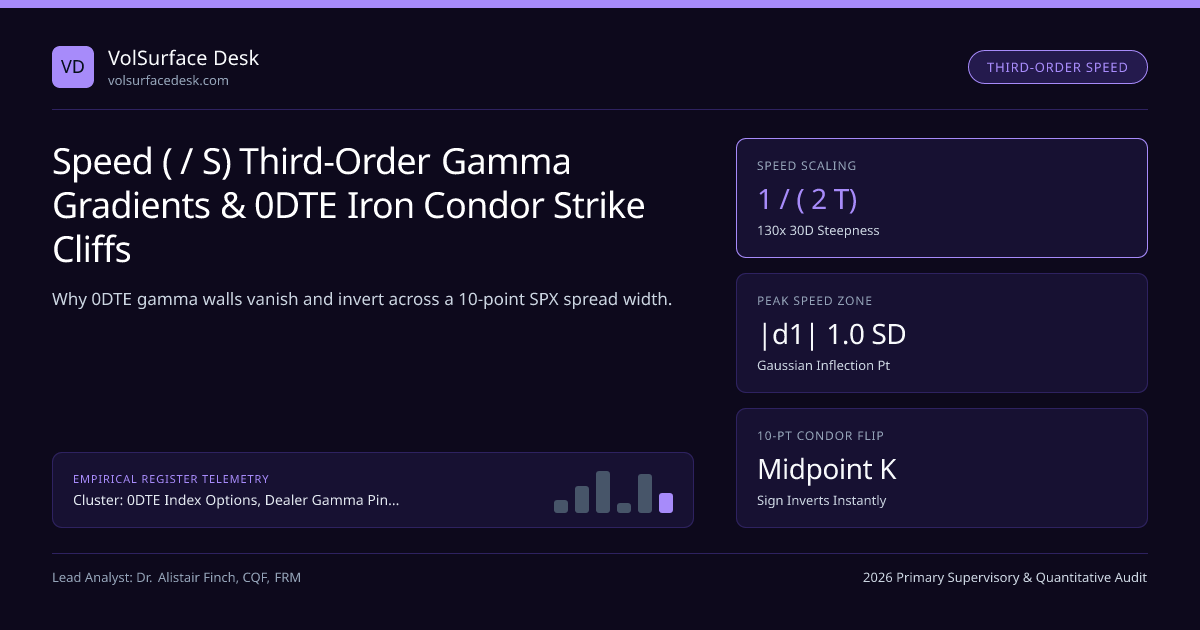
Ask an institutional options market maker why second-order Delta-Gamma Taylor approximations fail after 14:00 ET on 0DTE SPX books, and they will point immediately to Speed (∂Γ/∂S = ∂3V/∂S3) (Vomma, Zomma & Speed Mechanics). While Gamma measures the curvature of option value, Speed measures the spatial gradient of Gamma itself—how violently a portfolio's gamma accelerates or flips sign as the S&P 500 moves by just 5 to 10 points!
Within the 0DTE Index Options, Dealer Gamma Pinning, Vanna & Charm Rehedging silo and our 0DTE Dealer Gamma, Vanna & Charm Flows Guide, Speed explains both why retail 0DTE iron condors suffer catastrophic afternoon whipsaws and why seemingly rock-solid dealer "+GEX resistance walls" suddenly give way to vertical 25-point breakouts.
Analytical Formula and the 1/(σ2·T) Explosion of 0DTE Speed#
Differentiating Black-Scholes Gamma Γ = e^(−qT) · φ(d1) / (S · σ · √T) with respect to underlying spot price S produces Speed:
- Dominant Short-Dated Term (T → 0): Speed ≈ −exp(−q·T) · φ(d1) · d1 / (S2 · σ2 · T) !
- Gaussian Inflection Extrema: Because ∂[φ(z)]/∂z = −z·φ(z) peaks at |z| = 1.0, Speed hits maximum magnitude exactly ±1.0 standard deviation (σ·√T) below and above strike K!
- Worked 14:30 ET 0DTE SPX 5,870/5,880 Short Call Spread (SPX = 5,858 → 5,876, T = 1.5 hrs = 0.00023 yr, σ = 13.0%):
- 1-SD Width σ·√T·S = 11.5 SPX pts! At S = 5,858, Spread Γ = −0.011/pt; at S = 5,869, Speed surges Spread Γ to −0.034/pt (3.1x!); at S = 5,878, Spread Γ INVERTS to +0.026/pt!
Traders inspect strike-by-strike gamma bells and spread inversions directly in our Option Greeks & GEX Calculator and verify 1-SD intraday widths in the 0DTE Expected Move Calculator.
Anatomy of a Dealer 0DTE Condor Wing Breakout via Speed#
Why Retail 10-Wide 0DTE Iron Condors Sit Inside a Speed Trap#
Popular retail options platforms actively market defined-risk 10-point-wide 0DTE SPX iron condors (e.g., selling the 5,830/5,820 put spread and 5,870/5,880 call spread on Cboe) because Reg T margin requires only $1,000 minus credit received. Yet third-order Speed reveals two structural traps:
- Before 13:30 ET (1-SD ≈ 22 pts): A 10-point wing width is far narrower than σ·√T·S, so the long protective wing cancels ~75% of positive theta, forcing the seller to collect minimal credit ($1.15–$1.45) relative to $8.55 max loss.
- After 14:30 ET (1-SD ≈ 11 pts): Now σ·√T·S matches the 10-point spread width! The two legs form a classic Gaussian dipole whose Speed reaches its theoretical maximum right between the strikes. A single 8-point CME ES sweep triggered by headlines or 15:50 ET MOC imbalances drives delta from −0.14 to −0.72 in seconds, making stop-loss orders suffer severe slippage.
Speed Across Common Index Spread Geometries#
| 0DTE Spread Structure (1.5 Hrs Left) | Net Gamma Sign Inside Strikes | Peak Speed Danger Zone | Dealer Counterparty Hedging Impact |
|---|---|---|---|
| Short 10-Pt Iron Condor | Negative near inner strikes | 3–8 pts inside inner short strike | Dealers pin inner strike, then chase breakout past midpoint! |
| Long ATM Butterfly (20-Pt Wings) | Strong Positive at body | ±10 pts from center strike | Rapid collapse of long gamma into negative wing gamma on trend days |
| 1×2 Call Ratio Spread | Positive at K1, Uncapped Negative above K2 | From K1 + 1⁄2(K2−K1) through K2 + 1 SD | Extreme short Speed cliff above K2; triggers OCC STANS add-ons |
| 30-DTE Monthly Vertical (50-Pt) | Smooth, gentle gradient | Spread over ±125 SPX pts | Low Speed; second-order Vanna dominates |
Explosion of Peak Black-Scholes Speed as Expiration Approaches#

Institutional clearing members executing through Apex Futures or Global Futures combine Speed with Color (∂Γ/∂t) in real-time PDE grids so automated hedging algorithms anticipate sign flips before spot crosses the condor midpoint.
Frequently asked questions
Why does Speed explode much faster than Gamma in the final two hours of a 0DTE session?
While ATM Gamma scales as 1 / (S · σ · √T), Speed differentiates Gamma with respect to spot, introducing an extra 1 / (S · σ · √T) factor from ∂φ(d1)/∂S! Thus Speed scales as 1 / (S2 · σ2 · T)—growing 120x to 150x steeper in the last two hours than on a 30-day option.
Where is Speed zero and where does Speed peak around a single option strike?
Speed is near zero right at the peak of the Gamma bell curve (ATM, where d1 ≈ 0) and reaches positive and negative extrema at the inflection points of the Gaussian bell curve: |d1| ≈ 1.0 standard deviation away from the strike.
Why do tight 10-point-wide 0DTE SPX iron condors suffer dreadful risk-adjusted Sharpe ratios after 14:30 ET?
At 14:45 ET, 1 standard deviation on SPX is roughly ±11 points. A 10-point-wide spread sits entirely inside the maximum-Speed inflection zone, where a 6-point drift triples negative gamma and flips delta from -0.15 to -0.68 before a trader can adjust.
How does aggregate retail 0DTE iron-condor selling shape the dealer GEX cliff?
When retail traders sell 5,865/5,880 call spreads, dealers are LONG the 5,865 call (stabilizing +Gamma) and SHORT the 5,880 call (destabilizing -Gamma). If SPX breaks above 5,872.50, Speed flips dealer gamma sharply negative, fueling rapid breakouts through 5,880.
Publication record
- Published
- November 14, 2026
- Updated
- November 14, 2026
- Author
- Dr. Alistair Finch, CQF, FRM
- Review
- Review not recorded
- Automated fact check
- Passed in the stored pipeline record
- Source URLs
- 3 recorded
AI assistance recorded: anthropic/claude-opus-4.6. This field does not establish human review or source verification.
Academic & Institutional Attribution
Cite This Research & Embed Live Data Card
Standard academic & institutional research paper citation format.
Dr. Alistair Finch, CQF, FRM. (2026, November 14). Speed (∂Γ/∂S) Third-Order Gamma Gradients & 0DTE Iron Condor Strike Cliffs. VolSurface Desk. https://volsurfacedesk.com/desk-notes/speed-dgamma-dspot-0dte-iron-condor-pin-cliffsRelated Dealer Gamma Vanna Charm Flows & Institutional Briefings
Explore Dealer Gamma Vanna Charm Flows Hub (20) →Dealer Gamma Vanna Charm Flows
0DTE Index Options, Net Dealer Gamma (GEX), Vanna & Charm Rehedging Flows GuideDealer Gamma Vanna Charm Flows
Zomma (∂Γ/∂σ) Mechanics: How Implied Volatility Shocks Mutate Dealer GammaDealer Gamma Vanna Charm Flows
Color (∂Γ/∂t) Gamma Decay vs Final-Hour 0DTE ATM Pin Risk Before 16:00 ETDealer Gamma Vanna Charm Flows
Institutional Quarterly Equity Collar Rolls (JPM HEQT) & Strike PinningDealer Gamma Vanna Charm Flows
Nasdaq-100 (NDX & QQQ) vs S&P 500 (SPX) 0DTE Gamma Pinning & Vol SpreadsDealer Gamma Vanna Charm Flows
OCC STANS 20-Minute Intraday Risk Snapshots & 0DTE Margin Add-OnsDealer Gamma Vanna Charm Flows
FINRA Rule 4210 TIMS Portfolio Margin vs Reg T Haircuts for Index BooksDealer Gamma Vanna Charm Flows
Signed Dealer Gamma Reconstruction: Cboe Open-Close Data vs Naive OI GEXVix Futures Variance Swap Convexity
Cboe VVIX Vol-of-Vol & Jensen’s Inequality: The VIX Futures Convexity WedgeVix Futures Variance Swap Convexity
VIX 1×2 Call Ratios & Collars vs Direct SPX OTM Put Tail HedgesVix Futures Variance Swap Convexity
Ultra-Short VIX1D vs VIX9D, VIX & VIX3M Event Term-Structure KinksVix Futures Variance Swap Convexity
Wednesday Morning VIX SOQ Settlement (VRO) & SPX Strip Auction Mechanics
VolSurface Desk Data, Benchmarks & Contributor Records
CC BY 4.0 Open Data
Open Institutional Datasets (CSV / JSON) →
Download desk-compiled quantitative series & schemas.
2026 Reference Matrix
2026 Institutional Benchmarks & Thresholds →
Statutory capital, clearing, margin & rate conventions.
Editorial Records
Authors & Review Records →
View named contributors where those records are available.
Complete Index
Master Research & Dossier Archive →
Browse all published briefings by topic pillar & date.