
Vix Futures Variance Swap Convexity
Capped (2.5× Strike) vs Uncapped Variance Swaps: Left-Tail Gap Risk
Understand why institutional single-stock variance swaps mandate a 2.5× volatility cap while index variance trades both capped and uncapped: pricing embedded variance calls and mitigating bankruptcy log-return singularities.
Why does ln(St / S{t−1}) → −∞ as S_t → 0? In 2008, when Lehman Brothers, AIG, and Washington Mutual collapsed toward zero, banks and hedge funds short uncapped single-stock variance swaps discovered a terrifying mathematical singularity: a single −92% bankruptcy gap generates ln(0.08)2 = 6.38, contributing over 12,800 annualized variance points in a single afternoon while the underlying stock options below the lowest listed $2.50 strike didn't even exist to hedge it!
Within the VIX Term Structure, Variance Swaps, Vol-of-Vol VVIX & Tail Hedging silo and our VIX, Variance Swaps & Tail Hedging Guide, that trauma permanently reshaped OTC volatility markets—making the 2.5× Capped Variance Swap mandatory on single-name equities and optional on indices (OTC SPX Variance Swaps Benchmark).
Exact Payoff Bound, Maximum Seller Liability, and Cap Valuation#
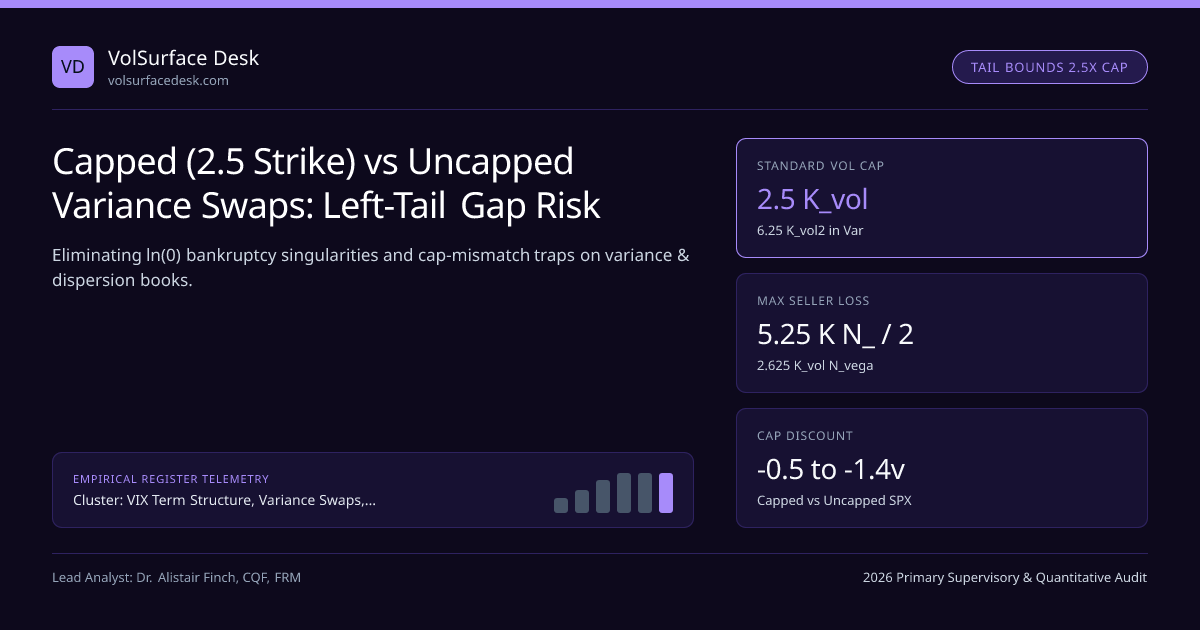
A 2.5× Capped Variance Swap truncates terminal annualized realized volatility at Capvol = 2.5 × Kuncapped (or 2.5 × Kcap), bounding realized variance at 6.25 × Kcap2. Decomposing the capped payoff exposes an embedded short call option on realized variance:
Quantitative Pricing Model: Capped (2.5x) vs Uncapped Variance Swaps & Crash Risk#
- Exact Seller Maximum Loss Bound: MaxLossseller = Nvar × (6.25 · Kcap2 − Kcap2) = 5.25 · [ Nvega / (2 · Kcap) ] · Kcap2 = 2.625 × Kcap × N_vega !
- Fair Capped Strike Discount: Kcap2 = E^Q[σreal2] − E^Q[ max(σreal2 − 6.25·Kcap2, 0) ] < K_uncapped2 !
- Worked $100,000 Vega SPX Comparison (Kuncapped = 16.00 vs Kcap = 15.20 [Cap at 38.00v]):
- If March 2020-style Crash hits σ_real = 62.00v: Uncapped Seller loses $3,125 × (3,844 − 256) = −$11,212,500! Capped Seller loses $3,289 × (1,444 − 231) = −$3,990,000 (saves $7.22M—a 64.4% tail-loss reduction!).
Traders inspect OTM VIX calls used to dynamically hedge that > 2.5× K_cap variance tail in our Black-Scholes Option Calculator.
Uncapped Singularity vs 2.5× Capped Variance Risk Architecture#
The March 2020 Dispersion Cap-Mismatch Post-Mortem#
One of the costliest institutional volatility errors of the past decade occurred inside S&P 500 Index Dispersion Books during Q1 2020:
| Variance Swap Contract Feature | Uncapped SPX Variance Swap | 2.5× Capped SPX Variance Swap | 2.5× Capped Single-Stock Variance |
|---|---|---|---|
| Typical Strike (K_vol) | Higher (16.00v baseline) | Discounted (15.15v, −0.85v cheaper) | Stock-specific (28v–55v), always capped |
| Static 1/K2 Hedgeability | Breaks below lowest listed SPX put (K_min) | Path-dependent near cap; hedged with OTM VIX calls | Essential due to earnings/M&A/bankruptcy jumps |
| Payout if Realized Vol = 4x Strike | 15.0 × K2 × N_var (Extreme acceleration!) | 5.25 × K2 × N_var (Strictly capped at 2.5×) | 5.25 × K2 × N_var (Capped!) |
| Dispersion Alignment Rule | NEVER short uncapped SPX vs long capped single-stocks! | Mandatory match against capped constituent basket! | Standard ISDA Equity Dispersion leg |
Fair Strike Discount (Kuncapped − Kcapped2.5x) by VVIX Regime#
Under bilateral ISDA SIMM initial margin rules supervised by CFTC, SEC, and ESMA, trading 2.5× Capped Variance substantially reduces counterparty credit reserve charges—making uncapped variance justifiable only for dedicated tail-risk funds willing to pay the 0.42–1.45v uncapped upgrade when VVIX is quiet. Compare live parameters in Corridor & Conditional Down-Variance Swaps Guide.
Frequently asked questions
How much cheaper is a 2.5x Capped SPX Variance Swap strike than an Uncapped SPX Variance Swap strike?
In calm markets (K_vol = 15%, cap at 37.5% vol = 1,406.25 variance), the embedded out-of-the-money call on variance (priced via VVIX and deep 2-delta SPX puts) typically discounts the capped strike by 0.45 to 1.15 vol points—widening past 2.5 vol points when Cboe SKEW and VVIX are elevated!
Why did dispersion desks lose money on cap mismatch during the March 2020 COVID crash?
Classic dispersion funds sold UNCAPPED SPX variance (at K = 16) and bought 2.5x CAPPED single-stock variance across 50 stocks. When SPX realized 62v in March 2020, their short index leg lost (622 - 162) = 3,588 var pts uncapped, while airlines/energy stocks hit their 2.5x caps and stopped paying!
Can a 2.5x Capped Variance Swap be replicated statically using a 1/K2 SPX option strip alone?
No! Static 1/K2 option strips replicate path-independent UNCAPPED terminal log-payoffs, whereas capping realized variance σ_real2 at 6.25·K_vol2 is path-dependent on quadratic variation! Dealers price and hedge the 2.5x cap dynamically via Heston/SLV PDEs and OTM VIX/variance calls.
How do ISDA confirmations handle corporate delistings or trading halts on single-stock variance swaps?
Standard ISDA Disruption Fallback provisions cap total realized variance at (2.5 × K_vol)2 upon insolvency/delisting and specify final valuation share marks, ensuring maximum seller loss is strictly deterministic at trade inception: MaxLoss_seller = N_var × 5.25 × K_vol2.
Publication record
- Published
- November 13, 2026
- Updated
- November 14, 2026
- Author
- Dr. Alistair Finch, CQF, FRM
- Review
- Review not recorded
- Automated fact check
- Passed in the stored pipeline record
- Source URLs
- 3 recorded
AI assistance recorded: anthropic/claude-opus-4.6. This field does not establish human review or source verification.
Academic & Institutional Attribution
Cite This Research & Embed Live Data Card
Standard academic & institutional research paper citation format.
Dr. Alistair Finch, CQF, FRM. (2026, November 14). Capped (2.5× Strike) vs Uncapped Variance Swaps: Left-Tail Gap Risk. VolSurface Desk. https://volsurfacedesk.com/desk-notes/capped-25x-vs-uncapped-variance-swap-crash-riskRelated Vix Futures Variance Swap Convexity & Institutional Briefings
Explore Vix Futures Variance Swap Convexity Hub (20) →Vix Futures Variance Swap Convexity
VIX Term Structure, OTC Variance Swaps, VVIX Vol-of-Vol & Tail Hedging GuideVix Futures Variance Swap Convexity
Corridor Variance & Conditional Down-Variance Swaps: Targeted Crash HedgesVix Futures Variance Swap Convexity
Cboe VVIX Vol-of-Vol & Jensen’s Inequality: The VIX Futures Convexity WedgeVix Futures Variance Swap Convexity
VIX 1×2 Call Ratios & Collars vs Direct SPX OTM Put Tail HedgesVix Futures Variance Swap Convexity
Ultra-Short VIX1D vs VIX9D, VIX & VIX3M Event Term-Structure KinksVix Futures Variance Swap Convexity
Wednesday Morning VIX SOQ Settlement (VRO) & SPX Strip Auction MechanicsVix Futures Variance Swap Convexity
Eurex VSTOXX (FVS) vs Cboe VIX (VX) Cross-Atlantic Volatility SpreadsVix Futures Variance Swap Convexity
Cross-Asset Spillover: CME SOFR Bachelier Swaption Vol & MOVE Into VIXFX Risk Reversal Strangle Surfaces
Overnight FX Central-Bank Event Variance Weights (FOMC, ECB, BoJ)FX Risk Reversal Strangle Surfaces
Sticky-Strike vs Sticky-Delta FX Smiles: Shadow-Delta Hedging MathFX Risk Reversal Strangle Surfaces
Vanna-Volga & First-Exit Attenuation on FX Double-No-Touch (DNT) BarriersFX Risk Reversal Strangle Surfaces
FX Reverse Knock-Out (RKO) Barriers: Discontinuous Gamma, Vanna & Overhedges
VolSurface Desk Data, Benchmarks & Contributor Records
CC BY 4.0 Open Data
Open Institutional Datasets (CSV / JSON) →
Download desk-compiled quantitative series & schemas.
2026 Reference Matrix
2026 Institutional Benchmarks & Thresholds →
Statutory capital, clearing, margin & rate conventions.
Editorial Records
Authors & Review Records →
View named contributors where those records are available.
Complete Index
Master Research & Dossier Archive →
Browse all published briefings by topic pillar & date.